Key takeaways
- Retinol is a retinoid, but it must be converted twice in the skin before it becomes active retinoic acid.
- Retinal (retinaldehyde) needs only one conversion step, so it is considered more potent than retinol.
- Topical retinoids such as adapalene, tretinoin, tazarotene and trifarotene have a strong recommendation in the 2024 AAD acne guideline.
- There is very little acne-specific evidence for retinol on its own.
- Adapalene is the least irritating drug retinoid and is available over the counter as a 0.1% gel.
- Retinoids should not be used during pregnancy, and tazarotene is formally contraindicated.
Retinol is a retinoid, but a weak, cosmetic one: your skin has to convert it twice before it becomes active, and there’s very little research on it for acne. The retinoids with real acne evidence are adapalene (available over the counter as a 0.1% gel), tretinoin, tazarotene and trifarotene, which the 2024 American Academy of Dermatology (AAD) guideline strongly recommends. Retinal (retinaldehyde) sits in between. If acne is your main goal, adapalene is the more evidence-based place to start; retinol is mainly an anti-aging ingredient.
What’s the difference between retinol and retinoids?
“Retinoid” is the family name. The AAD describes retinoids as “a catch-all for an array of vitamin A-based products used on skin,” and retinol as “a type of retinoid that’s routinely used to improve uneven skin tone, pigmentation, and texture” and that’s available over the counter.
DermNet groups the topical retinoids into generations: first-generation tretinoin (and topical isotretinoin), third-generation adapalene and tazarotene, and fourth-generation trifarotene. It lists retinol and retinaldehyde separately, as cosmetic additions. That split matters: the “drug” retinoids have been tested in acne trials and approved for acne; the cosmetic ones mostly haven’t.

How does retinol become active, and how much weaker is it?
Retinoids work by switching on genes in skin cells through retinoic acid receptors, as DermNet explains. Tretinoin is retinoic acid, so it’s active straight away. Retinol isn’t. As a 2022 review in Advances in Therapy explains, retinol is converted to retinoic acid “via retinaldehyde by dehydrogenases in a two-step oxidation process.” Retinal (retinaldehyde) needs only the second step, which is why a 2022 clinician’s guide in the Journal of Cutaneous Medicine and Surgery says it “is considered more potent” than retinol.
How much weaker is retinol? Estimates vary a lot, which tells you how uncertain these comparisons are:
- The 2022 Advances in Therapy review says retinol is “about tenfold less potent” than tretinoin, and that 0.25% retinol is considered about as effective as 0.025% tretinoin.
- The same review describes a 2016 study in which retinol’s effects on skin thickness and collagen genes were about two-fold lower than tretinoin’s.
- The clinician’s guide says retinoic acid “can be hundreds of times more potent” than cosmetic retinol or retinaldehyde.
One key caveat: nearly all of this comes from anti-aging research, not acne. Potency on wrinkles doesn’t automatically tell you how well something clears pores.
Retinol vs retinal vs prescription retinoids: what is the difference?
| Retinoid | How you get it | Strengths (examples) | Acne evidence | Irritation | Pregnancy |
|---|---|---|---|---|---|
| Retinol | Cosmetic, OTC | Varies by product | Very limited; no strong acne trials found | Less irritating than tazarotene (2006 review) | AAD: retinoids should not be used |
| Retinal (retinaldehyde) | Cosmetic, OTC | 0.1% in the trial cited here | Limited; one vehicle-controlled trial of a combination product | Low irritation profile | Avoid (retinoid) |
| Adapalene | OTC 0.1% gel; also prescription | 0.1% OTC | Strong (AAD 2024, topical retinoids) | Least irritating topical retinoid | Most experts advise stopping |
| Tretinoin | Prescription | Cream 0.025%, 0.05%, 0.1%; gel 0.01%, 0.025% | Strong (AAD 2024, topical retinoids) | Most irritating per DermNet | Most experts advise stopping |
| Tazarotene | Prescription | 0.1% cream for acne | Strong (AAD 2024, topical retinoids) | Common: peeling, dryness, redness, burning | Contraindicated |
| Trifarotene | Prescription | 0.005% cream | Strong (AAD 2024, topical retinoids) | Common: irritation, itching, sunburn | Ask your prescriber; AAD advises avoiding retinoids |
What’s the evidence for acne specifically?
Adapalene, tretinoin, tazarotene and trifarotene: good. The 2024 AAD guideline gives topical retinoids a strong recommendation, based on moderate-certainty evidence, according to MDedge’s summary, which notes they work on both clogged pores (comedones) and inflamed lesions and can help prevent scarring. A 2019 systematic review found efficacy differences between adapalene, tretinoin and tazarotene appeared minor, and concluded they “should be used in combination with benzoyl peroxide to optimize results.” Two examples from FDA labels:
- In 12-week trials of tazarotene 0.1% cream, 18% to 20% of people reached no or minimal acne, versus 6% to 11% on the vehicle cream.
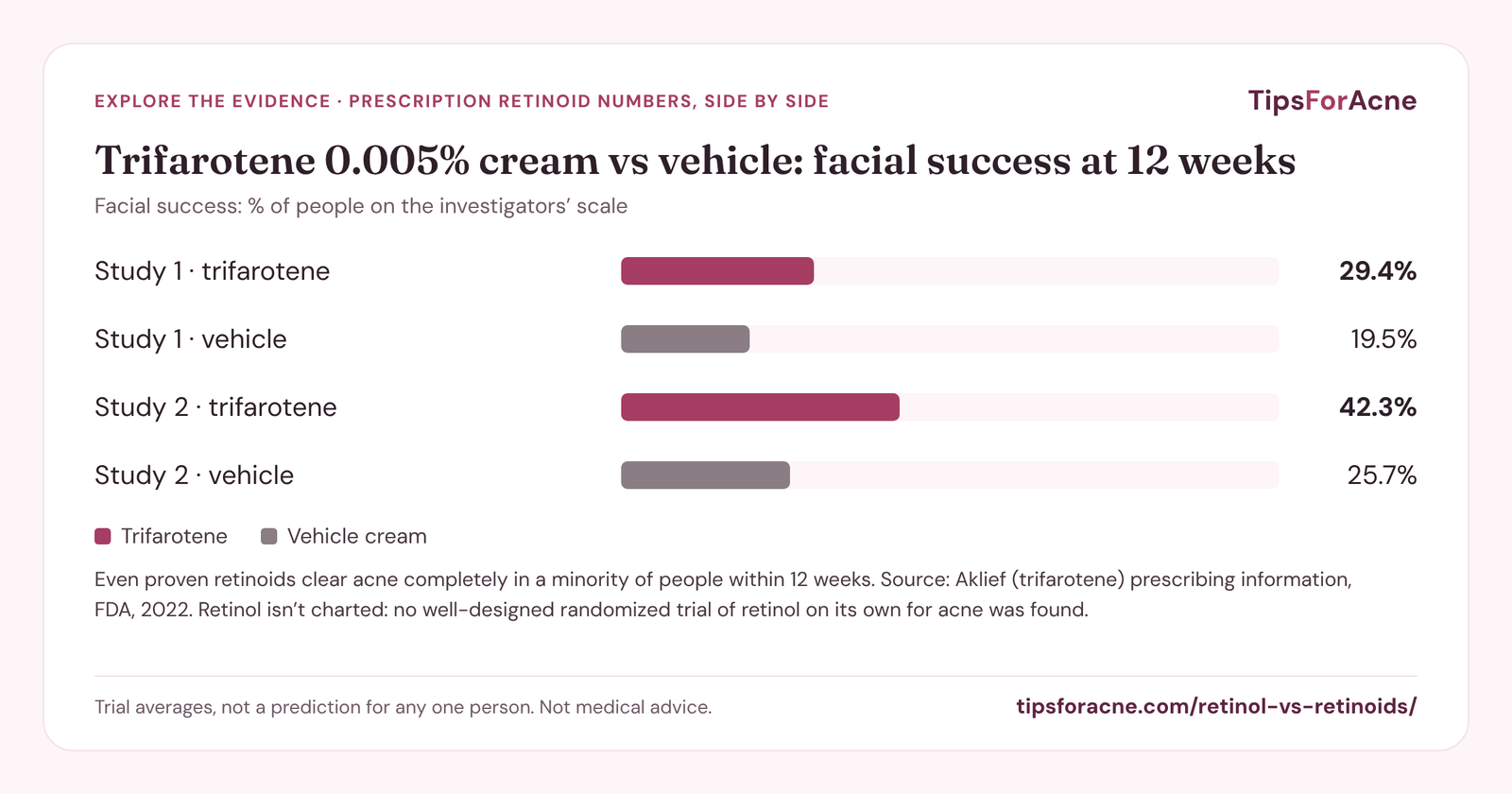
- In 12-week trials of trifarotene 0.005% cream, facial “success” on the investigators’ scale was 29.4% vs 19.5% in one study and 42.3% vs 25.7% in the other.
Those numbers are a useful reality check: even proven retinoids clear acne completely in a minority of people within 12 weeks. They work better as part of a combination and over longer periods.
Retinal: limited. A 2005 multicentre, vehicle-controlled trial of a cream combining 0.1% retinaldehyde with 6% glycolic acid found it reduced papules, pustules and comedones and was well tolerated. Because it paired two actives, it can’t tell you what retinal does alone.
Retinol: very limited. When I looked, I couldn’t find a well-designed randomized trial of retinol on its own for acne; its research base is mainly about photoaging. It isn’t among the topical treatments the 2024 AAD guideline recommends for acne. That doesn’t prove retinol does nothing for acne, but it’s an unproven choice when proven ones are available at the same drugstore.
Explore the evidence
Prescription retinoid numbers, side by side
Trifarotene 0.005% cream vs vehicle: facial success at 12 weeks
Facial success: % of people on the investigators’ scale
TrifaroteneVehicle cream
Even proven retinoids clear acne completely in a minority of people within 12 weeks. Source: Aklief (trifarotene) prescribing information, FDA, 2022. Retinol isn’t charted: no well-designed randomized trial of retinol on its own for acne was found.
Adverse effects: adapalene 0.1% vs tretinoin 0.05%
Adverse effects: % of people reporting them
AdapaleneTretinoin
From the trials included in a 2019 systematic review (Kolli et al., Am J Clin Dermatol). DermNet calls adapalene the least irritating topical retinoid and tretinoin the most.
Trial averages, not a prediction for any one person. Not medical advice.
Which is most irritating?
Irritation, sometimes called “retinoid dermatitis” (redness, peeling, dryness), is the main reason people quit. DermNet says “adapalene is the least irritating topical retinoid, and tretinoin the most,” while the clinician’s guide describes tazarotene as “one of the most potent of the retinoids.” In the 2019 review, adverse effects were reported by 19% of people on adapalene 0.1% compared with 62% on tretinoin 0.05% in the trials it summarized. The Advances in Therapy review notes retinal has a low irritation profile, and an older 2006 review reported that tazarotene causes more irritation than retinaldehyde or retinol.
The AAD advises using “the least-intense retinoid formula” you can find, applying it every other night at first and building up slowly, using a moisturizer, and applying retinoids at night with daytime sun protection because they make skin more sun-sensitive. It also warns that in darker skin tones, irritation can trigger dark marks. My guide on how to start adapalene walks through this step by step.
Expect a slow start. The tretinoin label says an “apparent exacerbation of inflammatory lesions may occur” in the early weeks, and that while results may be noticed after two to three weeks, “more than six weeks of therapy may be required” before definite benefits. More on that in retinoid purging.
Can you use retinoids in pregnancy?
Generally, no. The AAD states that “retinoids should not be used during pregnancy,” and since the AAD counts retinol as a retinoid, that caution reasonably extends to retinol products. For specific drugs:
- Tazarotene is contraindicated in pregnancy; its label requires a negative pregnancy test within 2 weeks before starting and adequate birth control.
- Tretinoin and adapalene: the AAD says most experts recommend stopping them during pregnancy. MotherToBaby notes it has generally been recommended to avoid topical retinoids, because oral retinoids are known to cause birth defects, though only a small amount of topical medication is likely absorbed.
- Adapalene OTC: the FDA’s approval materials say people who are “pregnant, planning to become pregnant or breastfeeding should ask a doctor before use.”
- Trifarotene: its label says case reports of birth defects with topical retinoids “do not establish a pattern,” but that’s not the same as proven safety. Ask your prescriber.
So which should you choose for acne?
- For most people with acne: adapalene 0.1% is the logical first retinoid. It was the first retinoid approved for OTC acne treatment (for ages 12 and up), it’s the gentlest of the drug retinoids, and it has strong guideline backing. See adapalene (Differin).
- If OTC adapalene isn’t enough after a few months: ask a clinician about tretinoin, tazarotene, trifarotene or a higher-strength adapalene.
- If your main goal is texture or fine lines, and your acne is mild or controlled: retinol or retinal is reasonable, but don’t count on it to treat acne.
- Combining with benzoyl peroxide: the pairing is well supported, but StatPearls advises against applying benzoyl peroxide at the same time as tretinoin because it can reduce tretinoin’s effectiveness; adapalene is compatible.
- Don’t layer multiple retinoids. Adding retinol on top of a prescription retinoid raises the risk of irritation, and I found no evidence that it adds benefit for acne.
When to see a dermatologist: if a retinoid hasn’t helped after a fair trial (the tretinoin label notes more than six weeks may be needed before definite benefits); if you have deep, painful nodules or cysts, or scarring; if irritation is so bad you can’t keep using a retinoid; if acne is affecting your mood; or if you’re pregnant, trying to conceive or breastfeeding and need a plan that avoids retinoids.
Kelsey’s take
Retinol turns out to be a retinoid with a lot of conversion steps between it and the active form, and very little acne-specific evidence. If acne is the goal, the drug retinoids like adapalene look like the stronger bet to me. I’d ask a dermatologist: is there any reason to choose retinol or retinal over adapalene for my acne, or is that mostly an anti-ageing choice?
Frequently asked questions
Is retinol or adapalene better for acne?
Adapalene. It’s a drug retinoid approved for acne and available OTC as a 0.1% gel, and topical retinoids have a strong recommendation in the 2024 AAD guideline. Retinol is a cosmetic ingredient that must be converted in the skin, and I couldn’t find strong trials of retinol alone for acne. Retinol is better thought of as an anti-aging product.
Is retinal stronger than retinol?
Generally, yes. Retinal (retinaldehyde) needs one conversion step to become retinoic acid, while retinol needs two, so a 2022 clinician’s guide describes retinal as more potent. Both are still considered much weaker than prescription tretinoin, and neither has much acne-specific evidence.
How much weaker is retinol than tretinoin?
Estimates vary. One 2022 review describes retinol as about tenfold less potent than tretinoin, another says retinoic acid can be hundreds of times more potent than cosmetic retinoids, and one study found retinol’s skin effects were about half as strong. These estimates come from anti-aging research, so they don’t translate neatly to acne.
Which retinoid is least irritating?
Among the drug retinoids, adapalene. DermNet describes it as the least irritating topical retinoid and tretinoin as the most. Starting with a low strength every other night, using a moisturizer, and building up slowly helps with any retinoid. Retinal is also described as having a low irritation profile.
Can I use retinol while pregnant?
The AAD says retinoids should not be used during pregnancy, and it counts retinol as a retinoid. Tazarotene is formally contraindicated, and most experts recommend stopping tretinoin and adapalene. Talk to your obstetrician or dermatologist about pregnancy-friendly alternatives such as azelaic acid or benzoyl peroxide.
Sources
- American Academy of Dermatology. Retinoid or retinol? aad.org
- DermNet. Topical retinoids. dermnetnz.org
- Milosheska D, Roškar R. Use of retinoids in topical antiaging treatments: a focused review of clinical evidence for conventional and nanoformulations. Advances in Therapy, 2022;39:5351-5375. link.springer.com
- Motamedi M, Chehade A, Sanghera R, Grewal P. A clinician’s guide to topical retinoids. Journal of Cutaneous Medicine and Surgery, 2022;26(1):71-78. journals.sagepub.com
- Kolli SS, Pecone D, Pona A, Cline A, Feldman SR. Topical retinoids in acne vulgaris: a systematic review. American Journal of Clinical Dermatology, 2019;20:345-365. link.springer.com
- Reynolds RV, Yeung H, Cheng CE, et al. Guidelines of care for the management of acne vulgaris. Journal of the American Academy of Dermatology, 2024;90(5):1006.e1-1006.e30. pubmed.ncbi.nlm.nih.gov
- Dotinga R. Inside the 2024 AAD Acne Guidelines: New Therapies Join Old Standbys. MDedge, March 2024. mdedge.com
- US Food and Drug Administration. Topical retinoid acne treatment approved for OTC use (Differin Gel 0.1%), 2016. fda.gov
- US National Library of Medicine, DailyMed. Tretinoin cream and gel prescribing information. dailymed.nlm.nih.gov
- US National Library of Medicine, DailyMed. Tazarotene cream 0.05% and 0.1% prescribing information. dailymed.nlm.nih.gov
- US Food and Drug Administration. Aklief (trifarotene) cream 0.005% prescribing information, 2022. accessdata.fda.gov
- Poli F, Ribet V, Lauze C, Adhoute H, Morinet P. Efficacy and safety of 0.1% retinaldehyde/6% glycolic acid for mild to moderate acne vulgaris: a multicentre, double-blind, randomized, vehicle-controlled trial. Dermatology, 2005;210:14-21. pubmed.ncbi.nlm.nih.gov
- American Academy of Dermatology. Is any acne treatment safe to use during pregnancy? aad.org
- MotherToBaby. Topical Acne Treatments (fact sheet, October 2023). NCBI Bookshelf. ncbi.nlm.nih.gov
- Mukherjee S, Date A, Patravale V, Korting HC, Roeder A, Weindl G. Retinoids in the treatment of skin aging: an overview of clinical efficacy and safety. Clinical Interventions in Aging, 2006;1(4):327-348. pubmed.ncbi.nlm.nih.gov
- Matin T, Patel P, Goodman MB. Benzoyl Peroxide. StatPearls (NCBI Bookshelf), updated March 2024. ncbi.nlm.nih.gov
Cite this page: TipsForAcne, “Retinol vs Retinoids for Acne: Potency, Evidence and Irritation”, tipsforacne.com/retinol-vs-retinoids/ (updated ). Free to quote with attribution and a link to this page.
Source links on this site are checked every month; last check . How sources are checked.