Key takeaways
- Combined oral contraceptives reduce inflamed and non-inflamed acne compared with placebo, according to a Cochrane review of 31 trials.
- Brands approved for acne include Beyaz, Estrostep, Ortho Tri-Cyclen and Yaz, but few consistent differences exist between pill types.
- Expect gradual results: improvement in about 2 to 3 months, with antibiotic-level results by around 6 months.
- Blood clot risk rises from about 1 to 5 per 10,000 women per year to 3 to 9 per 10,000 on the pill, and is higher still in pregnancy.
- Women over 35 who smoke, and people with clotting risks or migraine with aura, generally shouldn’t use combined pills.
- The pill is often paired with spironolactone and topical treatments rather than used alone.
Yes, birth control pills can treat acne. Combined oral contraceptives, the kind containing both an estrogen and a progestin, reduce acne lesions compared with placebo, and several are FDA-approved for acne. They’re slow, though: the AAD says most women notice improvement within about 2 to 3 months, and they carry a small but real blood-clot risk. The 2024 American Academy of Dermatology (AAD) guideline gives them a conditional recommendation. They’re a reasonable option mainly for people who also want contraception, and the decision belongs in a conversation with a clinician.
How can a birth control pill help acne?
Acne is partly driven by androgens, hormones such as testosterone that ramp up oil production. Combined pills have anti-androgenic effects, which is why they’re grouped with spironolactone as “hormonal therapies” for acne (Dermatology and Therapy review, 2025). The AAD says the pill has been found effective at treating “blackheads, whiteheads, pimples, and acne nodules and cysts” (AAD).
The type of pill matters. Progestin-only pills aren’t used this way, and NICE advises using a combined pill “in preference to the progestogen-only pill” for people on acne treatment who need contraception (NICE NG198). Some progestin-only methods may even worsen acne: one review cites a study in which progestin-only IUDs or implants were linked with new or worsening acne in 28.5% of users after 8 weeks (Dermatology and Therapy). If your breakouts cluster around your jaw and flare with your cycle, my guide to hormonal acne in adults explains the pattern.

Which birth control pills are FDA-approved for acne?
The AAD lists four brands approved for acne: Beyaz, Estrostep, Ortho Tri-Cyclen and Yaz (AAD). By ingredient, the approvals cover norgestimate with ethinyl estradiol (1997), norethindrone acetate with ethinyl estradiol (2001), and drospirenone with ethinyl estradiol (2007) (Fitzpatrick et al., Cutis 2017). Generic versions contain the same ingredients.
The label for Yaz shows what “approved for acne” looks like in practice. It’s indicated for moderate acne in women at least 14 years old who have started their periods and have no reasons to avoid oral contraceptives. It “should be used for the treatment of acne only if the patient desires an oral contraceptive for birth control” (FDA-approved Yaz label). Other combined pills that aren’t specifically approved for acne may still help. The Cochrane review below found few consistent differences between pill types.
What does the evidence show?
The best summary is a Cochrane review of 31 trials involving 12,579 women (Arowojolu et al., Cochrane). Its main findings:
- All the pills tested against placebo “reduced acne lesion counts, severity grades and self-assessed acne.” The authors concluded that the six pills evaluated in placebo-controlled trials were effective against both inflamed and non-inflamed facial acne.
- “Few important and consistent differences were found between COC types.” Pills with cyproterone acetate or chlormadinone acetate did somewhat better than levonorgestrel ones, and drospirenone looked somewhat better than norgestimate.
- How pills compare with other acne treatments “is unknown since only one trial addressed this issue.”
One important caveat: the Cochrane searches ran to January 2012, so newer trials aren’t included. The Yaz label adds concrete numbers from two six-cycle trials:
| Outcome after 6 cycles | Yaz | Placebo |
|---|---|---|
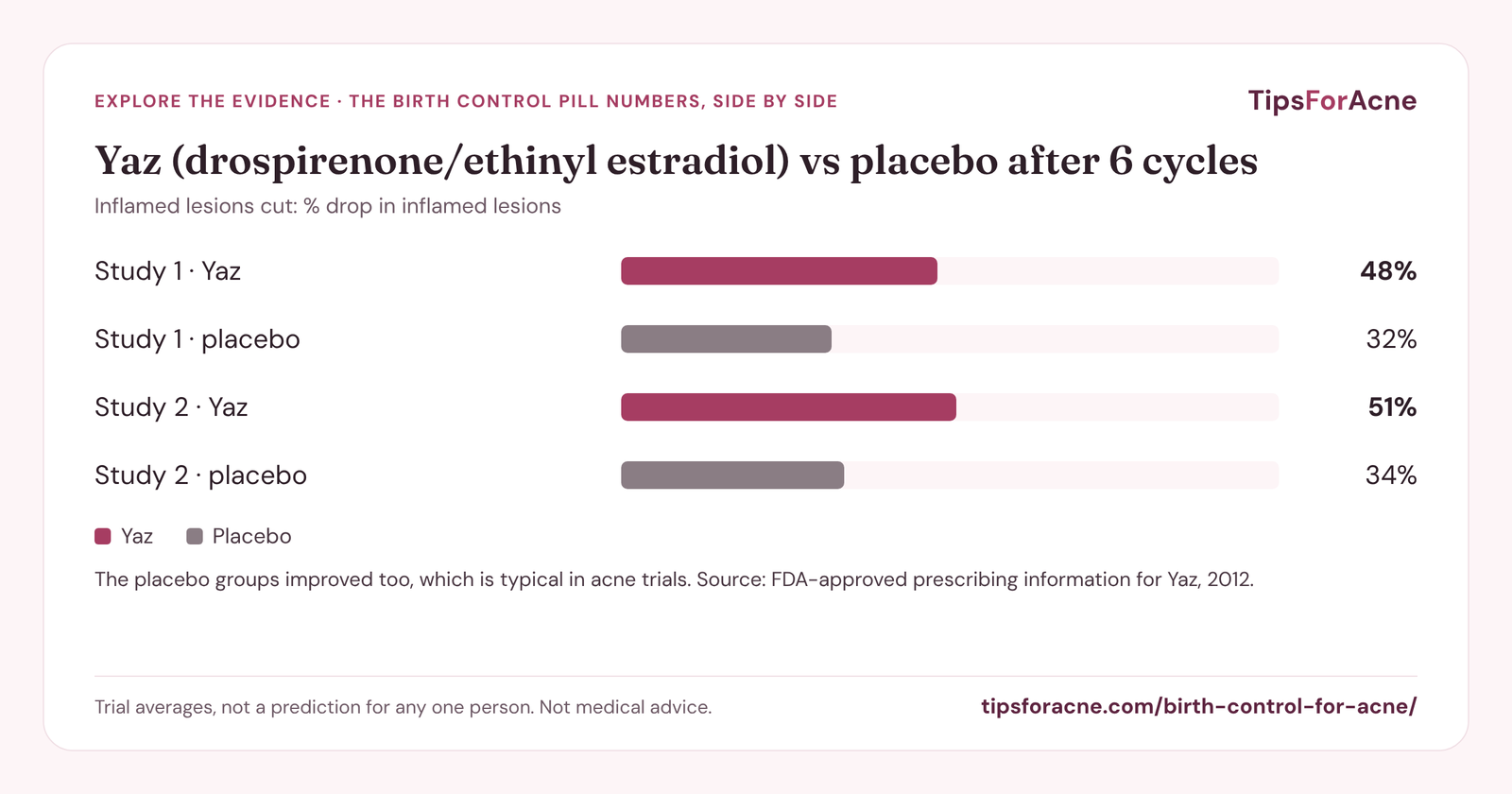
| Study 1: reduction in inflamed lesions | 48% | 32% |
| Study 1: reduction in non-inflamed lesions | 39% | 18% |
| Study 2: reduction in inflamed lesions | 51% | 34% |
| Study 2: reduction in non-inflamed lesions | 42% | 26% |
Combined oral contraceptive pills for acne: the key facts
| What it is used for | Hormonal pattern, Red inflamed spots |
|---|---|
| How you get it | Prescription |
| Guideline position (AAD 2024) | Conditional recommendation |
| Certainty of evidence | Moderate |
| How long before it works | 3–6 months |
| Use in pregnancy | Not applicable. |
| The main catch | The conditional rating reflects variability in what people want from a contraceptive, not weak efficacy. Clotting and blood-pressure considerations apply. |
How does combined oral contraceptive pills compare to the alternatives?
| Treatment | Guideline position | Certainty of evidence | How you get it | Time to work |
|---|---|---|---|---|
| Oral doxycycline | Strong | Moderate | Prescription | 6–12 weeks; usually capped at 3–4 months |
| Oral isotretinoin | Good practice statement | — | Prescription, with a pregnancy prevention programme | 4–6 months for a typical course; improvement often continues after stopping |
| Oral sarecycline | Conditional | High | Prescription | 12 weeks |
| Combined oral contraceptive pills this page | Conditional | Moderate | Prescription | 3–6 months |
| Spironolactone | Conditional | Moderate | Prescription | 3–6 months |
Ratings come from the 2024 AAD acne guideline (Reynolds RV et al.). A conditional recommendation does not mean weak evidence; two treatments in the full table have the best evidence on the site and are conditional purely on cost. All 58 treatments, with sources: the acne treatment evidence map.
Notice the placebo groups improved too. That’s typical in acne trials and a good reason to be skeptical of any single before-and-after story.
How long does birth control take to work for acne?
Longer than most people hope. The AAD says women notice improvement within 2 to 3 months on average (AAD), and the Yaz trials measured results after six cycles (label). A meta-analysis comparing pills with antibiotics, summarized in a 2025 review, found that antibiotics cut total lesions more at 3 months (48.0% vs 37.3%), but results were similar by 6 months (52.8% vs 55.0%) (Dermatology and Therapy). In other words, the pill is a slow starter that catches up. That’s also why it’s usually combined with topical treatment rather than used alone. My how long acne treatments take page covers realistic timelines.
Explore the evidence
The birth control pill numbers, side by side
Yaz (drospirenone/ethinyl estradiol) vs placebo after 6 cycles
Inflamed lesions cut: % drop in inflamed lesions
Non-inflamed lesions cut: % drop in non-inflamed lesions
YazPlacebo
The placebo groups improved too, which is typical in acne trials. Source: FDA-approved prescribing information for Yaz, 2012.
Total lesions cut: birth control pills vs antibiotics
Total lesions cut: % drop in total lesions
PillAntibiotics
A meta-analysis summarized in a 2025 review (Dermatology and Therapy): antibiotics were ahead at 3 months, results were similar by 6 months. The pill is a slow starter that catches up.
Trial averages, not a prediction for any one person. Not medical advice.
What are the risks and side effects?
The most serious risk is a blood clot in a vein (venous thromboembolism, or VTE). The Yaz label puts it in perspective (FDA-approved label):
- Among women not pregnant and not on the pill, 1 to 5 in 10,000 develop a VTE each year.
- Among women on combined pills, the estimate is 3 to 9 per 10,000 woman-years.
- Rates during pregnancy, and especially just after giving birth, are higher still.
- Risk is highest in the first year of use, and when restarting after a break of 4 weeks or more.
Pills containing drospirenone may carry a somewhat higher clot risk than those containing levonorgestrel; one review puts it at 1.0 to 3.3 times higher (Cutis 2017), while the Yaz label reports mixed study findings (label).
Who shouldn’t take combined pills? The Yaz label carries a boxed warning that smoking raises the risk of serious cardiovascular events, and women over 35 who smoke shouldn’t use it. Its contraindications include a high risk of blood clots, certain cancers, liver disease and kidney or adrenal problems (label). A 2025 review adds migraine with aura as a contraindication (Dermatology and Therapy). The AAD also mentions breakthrough bleeding and melasma (dark facial patches) as possible effects (AAD). The same review reports intermenstrual bleeding in about 10.5% of users, headache in 8.6% and nausea in 6.4% (Dermatology and Therapy).
Who is a good candidate?
Put simply: someone who has acne with a hormonal flavor, wants or is happy to use contraception, and has no reason to avoid estrogen. The AAD notes that the pill is generally considered safe for women, but that some women, including some aged 35 and older and those with a history of blood clots or stroke, may not be candidates (AAD). Screening matters more than you might think. In a 2017 survey of US dermatologists, only 59.4% correctly identified blood pressure of 160/100 mm Hg or higher as a reason not to prescribe a combined pill (Cutis 2017). So it’s reasonable to ask whoever prescribes it to walk you through your personal risk factors.
What do the guidelines say?
The 2024 AAD guideline recommends combined oral contraceptives conditionally, alongside spironolactone (Reynolds et al., JAAD 2024). NICE suggests considering adding a combined pill, such as co-cyprindiol or an alternative combined pill, for women whose first-line acne treatment hasn’t worked (NICE NG198). Both place the pill within a broader plan that includes topicals such as adapalene or benzoyl peroxide. See my overview of acne treatment options for where it fits.
Birth control vs spironolactone: which is better?
They’re different tools, and they’re often used together. Spironolactone is an anti-androgen tablet used off-label in adult women. It doesn’t prevent pregnancy, and it “can cause severe birth defects” (AAD). The combined pill does prevent pregnancy, which is one reason the two are paired. The AAD notes that “taking both spironolactone and the pill can increase effectiveness” (AAD). One study cited in a 2025 review found fewer menstrual irregularities when drospirenone/ethinyl estradiol was added to spironolactone than with spironolactone alone (15% vs 50%) (Dermatology and Therapy).
There’s no big head-to-head trial of the pill against spironolactone. Choice usually comes down to whether you want or can use estrogen-containing contraception, your clot risk, and side effects. For a routine that works alongside either, see my adult hormonal acne routine.
When to see a dermatologist: Hormonal pills are prescription-only, so a clinician will need to check your blood pressure, smoking status and medical history, including migraines with aura or any history of blood clots. See a dermatologist if your acne is deep, painful or scarring, if it hasn’t improved after a few months of treatment, or if you also have irregular periods, excess hair growth or rapid weight changes, which can point to an underlying hormonal condition. Get urgent care for leg pain or swelling, chest pain, sudden breathlessness or a sudden severe headache while on the pill.
Kelsey’s take
What I appreciated in the evidence is how honest it is: the pill clearly beats placebo, but slowly, and no single brand is a magic bullet. The clot numbers sounded scarier before I saw them next to the pregnancy risk. I’d ask a clinician: given my health history, is a combined pill safe for me, and would you pair it with spironolactone or a topical?
Frequently asked questions
Using the pill with other products
Short, sourced answers on combining the pill with other acne ingredients and medicines:
What is the best birth control pill for acne?
There’s no clear winner. A Cochrane review found few important and consistent differences between combined pill types. Brands approved for acne include Beyaz, Estrostep, Ortho Tri-Cyclen and Yaz, but other combined pills may help too. A clinician will weigh your clot risk and side effects.
How long does it take for birth control to clear acne?
The AAD says women notice improvement within about 2 to 3 months on average. In the Yaz trials, results were measured after six cycles. Antibiotics work faster at 3 months, but results were similar to the pill by 6 months, so give it several cycles alongside your topical routine.
Can the mini pill (progestin-only) help acne?
Progestin-only pills aren’t used to treat acne, and NICE recommends combined pills in preference to progestin-only pills for people on acne treatment. Some progestin-only methods, such as hormonal IUDs or implants, have been linked to new or worsening acne. Discuss your options with the person prescribing your contraception.
Will my acne come back if I stop the pill?
It may. There’s surprisingly little research on what happens after stopping, but the pill works on hormones only while you take it, so breakouts can return. Keeping a topical routine going, such as adapalene or benzoyl peroxide, and planning the switch with your clinician is a sensible way to reduce the chance of a rebound.
Is it safe to take birth control and spironolactone together?
They’re commonly combined. The AAD says taking both can increase effectiveness, and the pill provides the reliable contraception that matters because spironolactone can cause birth defects. One study also found fewer period irregularities with the combination than with spironolactone alone. A clinician should still check that both are safe for you.
Sources
- Reynolds RV, Yeung H, Cheng CE, et al. Guidelines of care for the management of acne vulgaris. Journal of the American Academy of Dermatology, 2024;90(5):1006.e1-1006.e30 (abstract via Henry Ford Health Scholarly Commons). scholarlycommons.henryford.com
- Arowojolu AO, Gallo MF, Lopez LM, Grimes DA. Combined oral contraceptive pills for treatment of acne. Cochrane Database of Systematic Reviews, CD004425.pub6 (searches to January 2012; plain language summary). cochrane.org
- American Academy of Dermatology. Stubborn acne? Hormonal therapy may help. aad.org
- American Academy of Dermatology. Acne: Diagnosis and treatment. aad.org
- US Food and Drug Administration. YAZ (drospirenone and ethinyl estradiol) tablets prescribing information, revised April 2012. accessdata.fda.gov
- Fitzpatrick L, Mauer E, Chen CL. Oral contraceptives for acne treatment: US dermatologists’ knowledge, comfort, and prescribing practices. Cutis, 2017;99:195-201. cdn.mdedge.com
- Hormonal Therapies for Acne: A Comprehensive Update for Dermatologists. Dermatology and Therapy, 2025;15(1):45-59. link.springer.com
- National Institute for Health and Care Excellence (NICE). Acne vulgaris: management (NG198), 2021. nice.org.uk
Cite this page: TipsForAcne, “Birth Control for Acne: Which Pills Work, How Long, and Risks”, tipsforacne.com/birth-control-for-acne/ (updated ). Free to quote with attribution and a link to this page.
Source links on this site are checked every month; last check . How sources are checked.