Key takeaways
- Tretinoin is a prescription topical retinoid, and the 2024 AAD guideline strongly recommends topical retinoids for acne.
- It comes as a cream (0.025%, 0.05%, 0.1%), gel, microsphere gel (0.04%, 0.1%) and lotion (0.05%).
- In 12-week label trials, microsphere gel cut total lesions by 32% to 45% versus 8% to 23% with vehicle.
- Irritation and an early flare are common; the label says an apparent worsening in the first weeks is not a reason to stop.
- Adapalene works about as well in comparisons and is gentler, but tretinoin offers more strengths.
- Topical retinoids are not recommended in pregnancy; talk to your clinician if you are pregnant, planning or breastfeeding.
Tretinoin is a prescription topical retinoid that has been used for acne for decades, and it works: it unclogs pores, reduces both blackheads/whiteheads and inflamed spots, and has solid trial data behind it. The trade-off is irritation. Most people do best starting low and slow, expecting a rough first few weeks, and judging results at around 12 weeks rather than 12 days. It is not recommended during pregnancy.
What is tretinoin?
Tretinoin (all-trans retinoic acid) is a vitamin A derivative applied to the skin. According to the US prescribing information, it decreases the “cohesiveness” of the cells lining the pore, which means fewer microcomedones (the tiny, invisible plugs that grow into blackheads, whiteheads and pimples), and it speeds up cell turnover in the follicle so existing comedones are pushed out.
It belongs to the same family as adapalene, tazarotene and trifarotene. The 2024 American Academy of Dermatology (AAD) acne guideline makes a strong recommendation for topical retinoids, and a summary of the guideline notes that this recommendation rests on moderate-certainty evidence. In the US, tretinoin needs a prescription; adapalene 0.1% is the only retinoid you can buy over the counter (more on that comparison below).

What strengths and forms does tretinoin come in?
MedlinePlus lists tretinoin as a cream, gel and lotion. Within those, several strengths and delivery systems exist. The table below only includes products whose US labels I actually read.
| Form | Strengths (per label) | Label age range | Notes |
|---|---|---|---|
| Cream | 0.025%, 0.05%, 0.1% | Safety under 12 not established | Applied once daily before bed |
| Gel | 0.025% | Not specified on the label I read | Label warns gels are flammable |
| Microsphere gel | 0.04%, 0.1% | 12 years and older | Tretinoin released from microspheres |
| Lotion | 0.05% | 9 years and older | Newer lotion formulation (approved 2018) |
Tretinoin for acne: the key facts
| What it is used for | Blackheads & whiteheads, Red inflamed spots, Keeping it clear, Dark marks |
|---|---|
| How you get it | Prescription |
| Guideline position (AAD 2024) | Strong recommendation |
| Certainty of evidence | Moderate |
| How long before it works | 8–12 weeks, often worse before better |
| Use in pregnancy | Contraindicated in pregnancy. |
| The main catch | Degrades in light and next to benzoyl peroxide in older gel formulations. Purging is common. |
How does tretinoin compare to the alternatives?
| Treatment | Guideline position | Certainty of evidence | How you get it | Time to work |
|---|---|---|---|---|
| Tretinoin this page | Strong | Moderate | Prescription | 8–12 weeks, often worse before better |
| Clindamycin + tretinoin (fixed dose) | Strong | Moderate | Prescription | 8–12 weeks |
| Tazarotene | Strong | Moderate | Prescription | 8–12 weeks |
| Tretinoin + benzoyl peroxide (encapsulated, Twyneo) | Strong | Moderate | Prescription | 8–12 weeks |
| Trifarotene | Strong | Moderate | Prescription | 8–12 weeks |
Ratings come from the 2024 AAD acne guideline (Reynolds RV et al.). A conditional recommendation does not mean weak evidence; two treatments in the full table have the best evidence on the site and are conditional purely on cost. All 58 treatments, with sources: the acne treatment evidence map.
Higher strength does not automatically mean better. The vehicle (cream vs gel vs lotion) changes how drying the product feels, and many dermatologists start with a lower strength or a gentler base, then move up if the skin tolerates it. Which one makes sense for you is a prescriber’s call.
What does the evidence show?
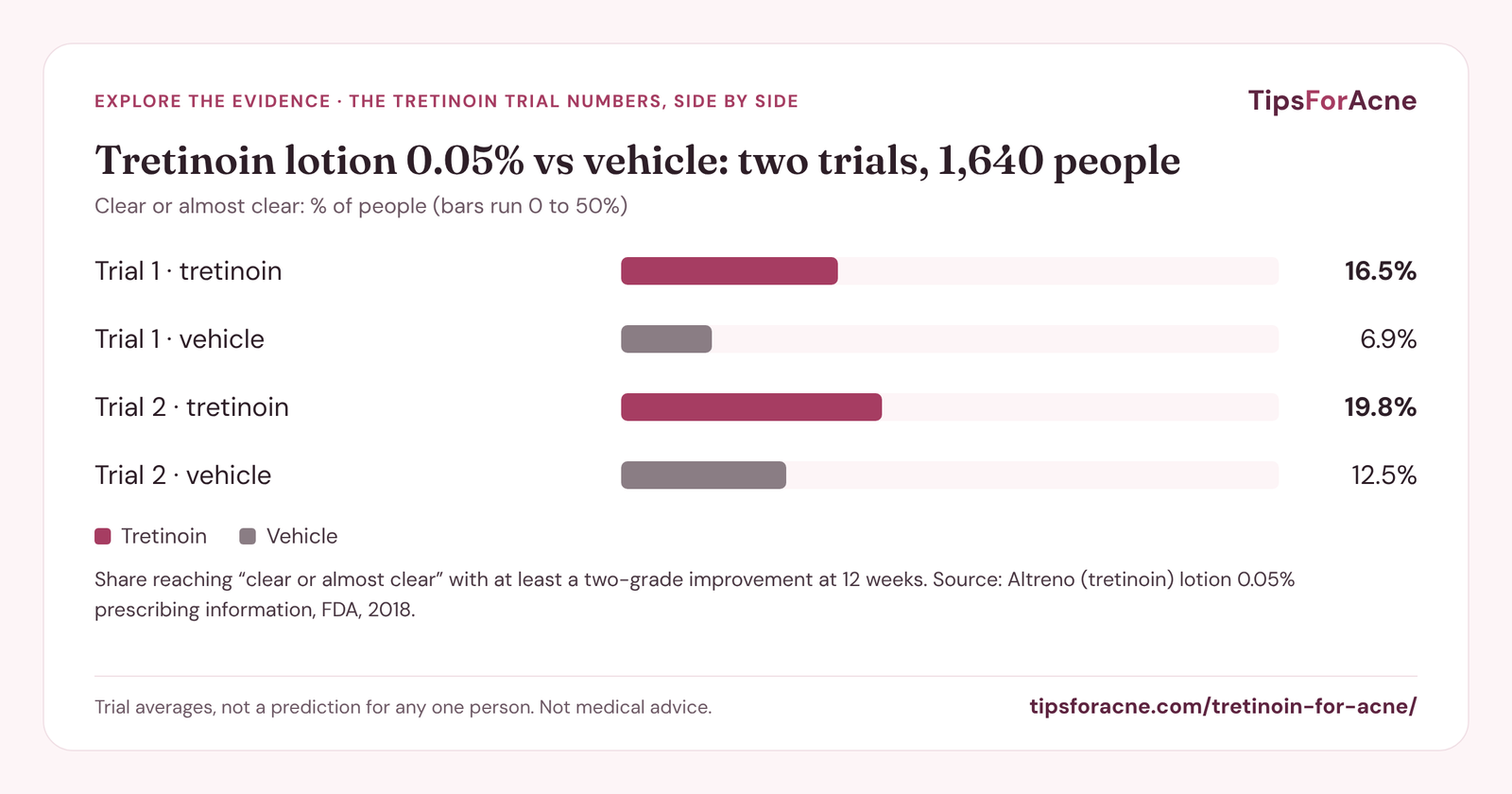
The cleanest data come from the vehicle-controlled trials that supported FDA approval. In four 12-week trials of tretinoin microsphere gel, total lesion counts fell by 32% to 45% with tretinoin versus 8% to 23% with the inactive vehicle cream. For the lower 0.04% strength, total lesions dropped 40% vs 8% in one trial and 35% vs 20% in the other. In two trials of tretinoin lotion 0.05% involving 1,640 people, 16.5% and 19.8% reached “clear or almost clear” with at least a two-grade improvement, compared with 6.9% and 12.5% on vehicle.
Those numbers are worth sitting with. Tretinoin is a real treatment, but “clear or almost clear in 12 weeks” happened for a minority of trial participants. Most people improve rather than fully clear, which is why guidelines pair retinoids with other agents. The UK’s NICE guideline (NG198), for example, lists a fixed combination of tretinoin with clindamycin as one of its first-line 12-week options for acne of any severity.
An honest caveat: a 2021 network meta-analysis of topical acne treatments (40 trials, 18,089 participants) rated its overall confidence in the evidence as low. On the outcome of investigator-rated “clear or almost clear,” every treatment beat vehicle except tretinoin alone (odds ratio 0.83, 95% CI 0.46 to 1.52; low confidence). I don’t read that as “tretinoin doesn’t work,” given the label trials above, but it is a reminder that head-to-head evidence between topical products is patchier than marketing suggests.
Explore the evidence
The tretinoin trial numbers, side by side
Tretinoin lotion 0.05% vs vehicle: two trials, 1,640 people
Clear or almost clear: % of people (bars run 0 to 50%)
TretinoinVehicle
Share reaching “clear or almost clear” with at least a two-grade improvement at 12 weeks. Source: Altreno (tretinoin) lotion 0.05% prescribing information, FDA, 2018.
Tretinoin microsphere gel 0.04% vs vehicle: drop in total lesions
Total lesions cut: % drop in total lesion count
TretinoinVehicle
Across all four 12-week microsphere gel trials, total lesions fell 32% to 45% on tretinoin vs 8% to 23% on vehicle; these are the two 0.04% trials. Source: Retin-A Micro prescribing information, FDA, 2025.
Adverse events: tretinoin 0.05% vs adapalene 0.1%
Adverse events: % of people reporting one
TretinoinAdapalene
From the comparison summarized in a 2019 systematic review (Kolli et al., Am J Clin Dermatol). A 1998 meta-analysis of five trials (900 patients) found adapalene 0.1% matched tretinoin 0.025% for total lesion reduction.
Trial averages, not a prediction for any one person. Not medical advice.
How do you start tretinoin without wrecking your skin barrier?
The label and the major patient resources agree on the basics:
- Night-time, once a day (at most). The tretinoin cream label directs once-daily use before bedtime.
- Dry skin first. The same label suggests waiting 20 to 30 minutes after washing before applying, because damp skin can increase irritation.
- Small amount, whole area. MedlinePlus advises a thin layer over the affected area, not just on individual spots. Retinoids work partly by preventing new plugs.
- Go slow. The AAD suggests starting with the least intense formula and using it every other night, slowly building up, with a moisturizer to help prevent irritation.
- Sunscreen daily. The label says to minimize sun exposure, and not to apply tretinoin to sunburned skin until it has fully recovered.
- Don’t stack harsh products. The label advises caution with medicated or abrasive cleansers, strongly drying soaps and cosmetics, and high-alcohol or astringent products.
If irritation gets out of hand, the label says to use it less often, pause temporarily or stop. That’s a legitimate strategy, not a failure. For a step-by-step ramp-up schedule (written for adapalene but equally applicable), see how to start adapalene.
Irritation, dryness and “purging”: what’s normal?
Irritation is the main reason people quit tretinoin. DermNet describes “retinoid dermatitis” (redness, peeling, dry skin) and notes tretinoin is the most irritating of the topical retinoids, with adapalene the least. In the microsphere gel trials, about half of people on the 0.04% strength had some skin irritation at week 2, fewer than 10% had moderate irritation, and 1.3% stopped because of it. Wind and cold weather can also make it worse, according to the label.
What people call “purging” is written into the label, too: “During the early weeks of therapy, an apparent exacerbation of inflammatory lesions may occur,” and this “should not be considered a reason to discontinue therapy” (tretinoin cream and gel label). MedlinePlus is more specific: acne “probably will get worse” during the first 7 to 10 days, should improve in 2 to 3 weeks, and sometimes needs more than 6 weeks. DermNet says it may take 12 weeks or longer to see improvement. Blistering, crusting, swelling or pain is not purging, and hives or throat symptoms are a stop-and-call-someone situation. I cover how to tell a flare from a reaction in retinoid purging.
If you have medium or dark skin, irritation matters more. A 2021 review on topical retinoids in skin of color points out that retinoid irritation can itself worsen hyperpigmentation, even though tretinoin 0.1% cream improved dark spots in a trial of 68 Black patients. Gentle ramp-up is doubly important here.
Tretinoin vs adapalene: which is better?
For most people, the honest answer is “similar results, different tolerability.” A 1998 meta-analysis of five randomized trials (900 patients) found adapalene 0.1% gel matched tretinoin 0.025% gel for total lesion reduction, worked slightly faster at week 1, and was considerably better tolerated at every time point. A 2019 systematic review of topical retinoids reported adverse events in 62% of people on tretinoin 0.05% versus 19% on adapalene 0.1% in the comparison it summarized.
Practical differences: adapalene 0.1% is sold over the counter for ages 12 and up, while tretinoin needs a prescription but offers more strengths, which gives a prescriber room to step up. Tretinoin is also used for sun damage; DermNet notes long-term use (more than 6 months) can reduce fine wrinkling and sun spots, which some adults weigh as a bonus. Neither retinoid is recommended during pregnancy. Full details on the OTC option are in adapalene (Differin) for acne.
Can you use tretinoin while pregnant or breastfeeding?
Guidance says avoid it in pregnancy. The AAD says experts recommend stopping tretinoin and adapalene during pregnancy, and NICE states that topical retinoids are contraindicated during pregnancy and when planning a pregnancy. The concern is that oral retinoids such as isotretinoin cause serious birth defects.
The actual risk from the skin form appears low. MotherToBaby (2024) explains that only a small amount is absorbed through the skin, and that studies of topical use have not shown an increased chance of birth defects, though scattered case reports exist, so the cautious approach is still to avoid it. The 2025 microsphere gel label similarly says published studies over decades “have not established a drug-associated risk” of major birth defects or miscarriage. If you used tretinoin before you knew you were pregnant, that’s a reason to tell your OB, not a reason to panic.
For breastfeeding, LactMed (NIH) says topical tretinoin hasn’t been studied but, because it is poorly absorbed, is considered low risk to the nursing infant. Still, run it by your clinician. My roundup of alternatives is in pregnancy-safe acne treatment.
When to see a dermatologist: if your acne hasn’t improved after about 12 weeks of consistent use, if irritation is severe (blistering, swelling, crusting or pain), if you have painful nodules or cysts or are scarring, if dark marks are getting worse, or if you are pregnant, trying to conceive or breastfeeding. A dermatologist can adjust strength, vehicle and frequency, or add or switch treatments.
Kelsey’s take
After reading the labels and the comparison trials, I see tretinoin as a proven but fussy tool: it works, yet most of the battle is tolerating the first two months. The adapalene data make me think the gentler option is a perfectly reasonable first step, with tretinoin as the step up. If I were starting it, I’d ask my dermatologist which strength and base suit my skin tone and dryness, and how they’d want me to handle an early flare before I panic and quit.
Frequently asked questions
The benzoyl peroxide question
The claim that benzoyl peroxide destroys tretinoin is real, older than you think, and depends entirely on which tretinoin you have. See what the stability studies actually found.
Using tretinoin with other products
Short, sourced answers on combining tretinoin with other acne ingredients and medicines:
- Tretinoin and Azelaic Acid: Yes.
- Tretinoin and Benzoyl Peroxide: Usually yes.
- Tretinoin and Clindamycin: Yes.
- Tretinoin and Hydroquinone: Only with a clinician.
- Tretinoin and Niacinamide: Usually yes, and plausibly helpful.
- Tretinoin and Salicylic Acid: Usually yes.
- Tretinoin and Vitamin C: Usually yes.
How long does tretinoin take to work for acne?
Expect a few weeks of adjustment. MedlinePlus says acne may look worse in the first 7 to 10 days and should improve in 2 to 3 weeks, sometimes more than 6. DermNet notes it can take 12 weeks or longer for worthwhile improvement, so most people should give it about three months before deciding it isn’t working.
Is tretinoin better than adapalene?
Not clearly. A meta-analysis of five trials found adapalene 0.1% gel reduced lesions about as well as tretinoin 0.025% gel and was noticeably better tolerated. Tretinoin’s advantages are more strength options and data on sun damage; adapalene’s are gentleness and over-the-counter access.
What strength of tretinoin should I start with?
That’s a prescriber’s decision, but lower strengths or gentler bases are commonly used first, and the AAD suggests starting with the least intense retinoid formula every other night and building up. Higher strength is not automatically more effective, and irritation is the main reason people quit tretinoin.
Does tretinoin cause purging?
An early flare is expected. The tretinoin label says an apparent worsening of inflamed spots may occur in the early weeks and should not be a reason to stop. Blistering, swelling, crusting, pain or hives are different: those are signs of irritation or a reaction and need a call to your prescriber.
Can I use tretinoin while pregnant?
Guidance says no. The AAD and NICE both advise against topical retinoids during pregnancy and when planning one. MotherToBaby notes little is absorbed and studies haven’t shown increased birth defects, so accidental early use is a reason to tell your OB, not panic.
Sources
- American Academy of Dermatology. American Academy of Dermatology issues updated guidelines for the management of acne (on Reynolds RV et al., J Am Acad Dermatol, 2024). aad.org
- Dotinga R. Inside the 2024 AAD Acne Guidelines: New Therapies Join Old Standbys. MDedge, March 2024. mdedge.com
- US National Library of Medicine, DailyMed. Tretinoin cream and gel prescribing information (revised 2012). dailymed.nlm.nih.gov
- US National Library of Medicine, DailyMed. Tretinoin cream 0.1% prescribing information. dailymed.nlm.nih.gov
- US Food and Drug Administration. Retin-A Micro (tretinoin) gel microsphere 0.04% and 0.1% prescribing information, 2025. accessdata.fda.gov
- US National Library of Medicine, DailyMed. Retin-A Micro (tretinoin gel) microsphere 0.1% and 0.04% label. dailymed.nlm.nih.gov
- US Food and Drug Administration. Altreno (tretinoin) lotion 0.05% prescribing information, 2018. accessdata.fda.gov
- MedlinePlus (US National Library of Medicine). Tretinoin Topical. medlineplus.gov
- DermNet. Topical retinoids. dermnetnz.org
- Cunliffe WJ, Poncet M, Loesche C, Verschoore M. A comparison of the efficacy and tolerability of adapalene 0.1% gel versus tretinoin 0.025% gel in patients with acne vulgaris: a meta-analysis of five randomized trials. British Journal of Dermatology, 1998;139(s52):48-56. academic.oup.com
- Kolli SS, Pecone D, Pona A, Cline A, Feldman SR. Topical retinoids in acne vulgaris: a systematic review. American Journal of Clinical Dermatology, 2019;20:345-365. link.springer.com
- Stuart B, Maund E, Wilcox C, et al. Topical preparations for the treatment of mild-to-moderate acne vulgaris: systematic review and network meta-analysis. British Journal of Dermatology, 2021;185:512-525. orca.cardiff.ac.uk
- American Academy of Dermatology. Retinoid or retinol? aad.org
- Callender VD, Baldwin H, Cook-Bolden FE, Alexis AF, Stein Gold L, Guenin E. Effects of topical retinoids on acne and post-inflammatory hyperpigmentation in patients with skin of color: a clinical review and implications for practice. American Journal of Clinical Dermatology, 2022;23(1):69-81. link.springer.com
- MotherToBaby. Topical Tretinoin (fact sheet, July 2024). mothertobaby.org
- American Academy of Dermatology. Is any acne treatment safe to use during pregnancy? aad.org
- National Institute for Health and Care Excellence (NICE). Acne vulgaris: management (NG198), 2021. nice.org.uk
- Drugs and Lactation Database (LactMed). Tretinoin. NCBI Bookshelf, revised October 2024. ncbi.nlm.nih.gov
- US National Library of Medicine, DailyMed. Differin (adapalene gel 0.1%) OTC Drug Facts label. dailymed.nlm.nih.gov
Cite this page: TipsForAcne, “Tretinoin for Acne: Strengths, Evidence, and How to Start”, tipsforacne.com/tretinoin-for-acne/ (updated ). Free to quote with attribution and a link to this page.
Source links on this site are checked every month; last check . How sources are checked.