Key takeaways
- Acne affects an estimated 9.4% of people worldwide and up to 50 million Americans each year.
- Blackheads and whiteheads are non-inflamed clogged pores; papules, pustules, nodules and cysts are inflamed.
- There is no single official severity scale, but UK NICE uses 35+ inflamed spots or 3+ nodules to define moderate to severe acne.
- Topical retinoids and benzoyl peroxide have the strongest guideline backing for everyday acne; nodules and cysts need prescription care.
- Scarring can follow even mild acne, and delaying effective treatment is a key modifiable risk factor.
- Give any new routine at least 6 to 8 weeks before judging it.
Acne is not one single thing. Dermatologists sort it two ways: by the type of spot (non-inflamed blackheads and whiteheads, or inflamed papules, pustules, nodules and cysts) and by overall severity (roughly mild, moderate or severe). Knowing which you are dealing with is the quickest way to tell whether drugstore products are a reasonable first step or whether you need a dermatologist sooner rather than later.
Already know what you’re dealing with? Jump to acne treatment options for what the evidence says about each treatment, from drugstore to prescription.
How common is acne?
Very. A global review of acne epidemiology estimated that acne affects 9.4% of the world’s population at any one time, making it the eighth most prevalent disease worldwide. In the US, the American Academy of Dermatology (AAD) calls acne the most common skin condition in the country, affecting up to 50 million Americans a year, and notes that roughly 85% of people aged 12 to 24 have at least minor acne.
Teens get most of the attention, but acne is not only a teenage problem. The NIH’s StatPearls review of acne vulgaris puts adolescent prevalence estimates anywhere from 35% to over 90% depending on the study, and notes that acne after adolescence mostly affects women. If that’s you, I’ve gone deeper on the adult pattern in hormonal acne in adults.

What actually causes an acne spot?
Every acne lesion starts in a pilosebaceous unit, the hair follicle plus its oil gland. According to StatPearls, four processes drive acne: extra sebum (oil) production, follicles that shed skin cells abnormally and plug up (hyperkeratinization), overgrowth of the skin bacterium Cutibacterium acnes, and inflammation. Androgen hormones stimulate the oil glands, which is why acne often starts around puberty.
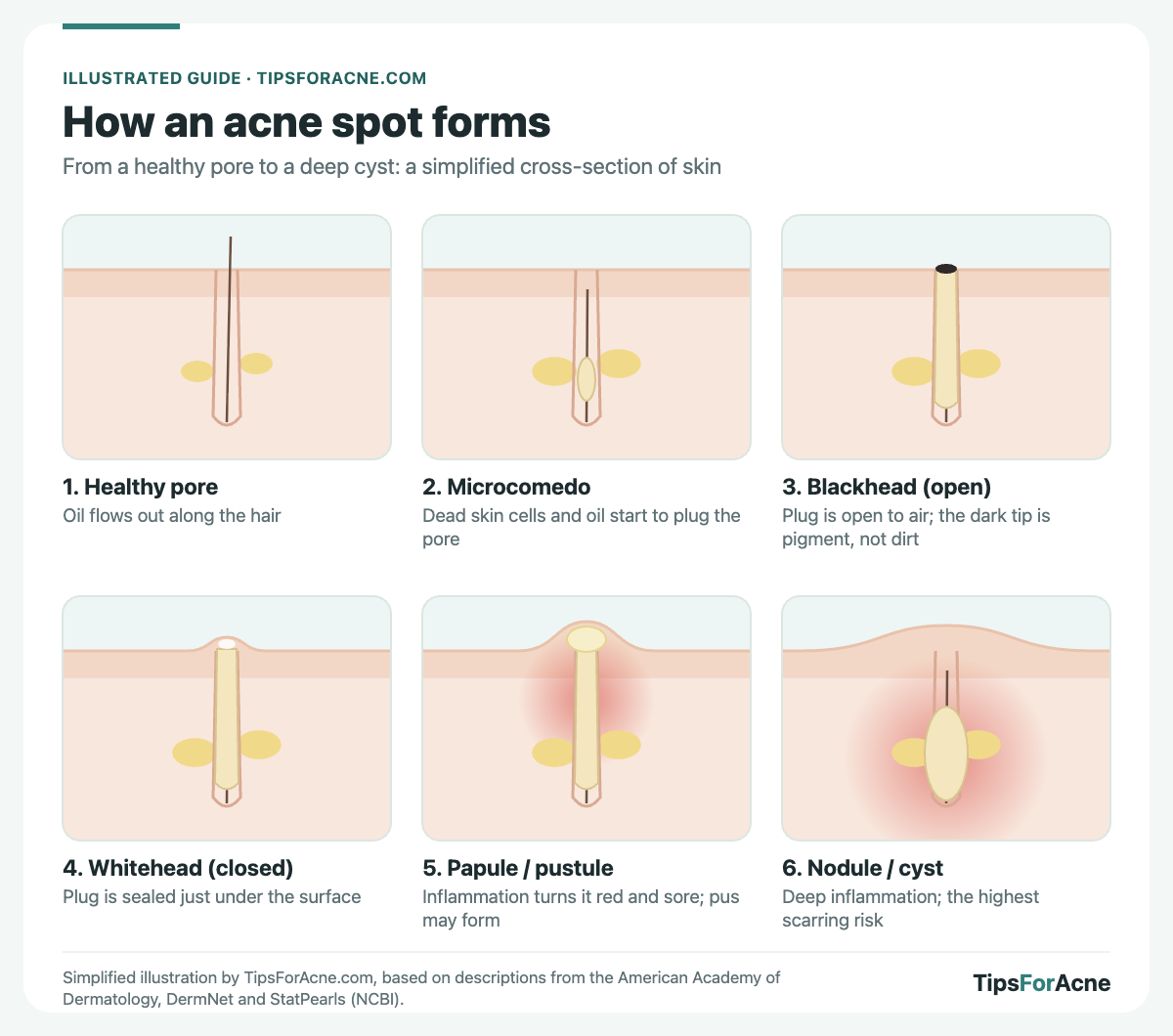
The very first lesion is a microcomedo, a plug too small to see. From there it can become a visible comedo (blackhead or whitehead) or, if inflammation kicks in, an inflamed spot. That progression is the reason most effective treatment plans aim to prevent new plugs rather than just attack the spots you can see.
What are the different types of acne?
Non-inflammatory acne: whiteheads and blackheads
Comedones are clogged pores without much redness. MedlinePlus explains it simply: if the top of the plug is white, it’s a whitehead; if it’s dark, it’s a blackhead. Whiteheads are closed comedones (the pore opening is blocked beneath the skin surface), while blackheads are open. The dark colour is surface pigment (melanin), not dirt, so scrubbing harder won’t wash it away. There’s a full breakdown in blackheads vs whiteheads.
Papules
The AAD describes papules as small, red bumps that feel hard. They happen when the wall of a clogged follicle becomes inflamed, and there’s no visible pus head.
Pustules
Pustules are what most people picture as “pimples”: inflamed bumps with a yellow or white centre filled with fluid. The AAD’s advice is to resist the temptation to pop them, because squeezing can push debris deeper and raise the risk of scarring (more on that in should you pop pimples?).
Nodules and cysts
These are the deep, often painful lumps. The AAD explains that when inflammation goes deep into the skin, an acne nodule or cyst develops, and its patient guide warns that these lesions penetrate deep into the skin and often cause permanent acne scars. The AAD is blunt that you’ll need a dermatologist’s help for this type. StatPearls groups these deepest lesions under “nodulocystic acne.” I’ve covered this in detail in cystic acne.
| Lesion type | What it looks like | Inflamed? | Scarring risk | Typical starting point |
|---|---|---|---|---|
| Whitehead (closed comedo) | Tiny white or skin-coloured bump; pore blocked under the surface | No | Low | Topical retinoid plus benzoyl peroxide wash |
| Blackhead (open comedo) | Dark dot in an open pore; the colour is pigment, not dirt | No | Low | Topical retinoid plus benzoyl peroxide wash |
| Papule | Small, red, hard bump with no head | Yes | Moderate if picked or widespread | Benzoyl peroxide or salicylic acid wash; see a dermatologist if extensive |
| Pustule | Red bump with yellow or white centre | Yes | Moderate, higher if squeezed | Benzoyl peroxide or salicylic acid product; don’t pop |
| Nodule / cyst | Deep, painful lump under the skin | Yes (deep) | High | Dermatologist; prescription treatment |
How is acne severity graded: mild, moderate or severe?
Here’s something that surprised me: there is no single official scale. In its guidance for drug trials, the US Food and Drug Administration states that “there is no single, standardized grading system for severity of acne.” Dermatologists and researchers use several different scales, though the 2024 AAD acne guideline advises clinicians to use some consistent grading approach to guide treatment decisions.
The UK’s NICE guideline gives one of the clearest, count-based definitions (quoted here from NHS Scotland’s acne pathway, which adapts NICE 2021):
- Mild to moderate: any number of comedones, and/or up to 34 inflammatory lesions, and/or up to 2 nodules.
- Moderate to severe: 35 or more inflammatory lesions and/or 3 or more nodules.
StatPearls describes the extremes in plainer terms: mild acne means scattered comedones or small inflamed papules without scarring, while moderate-to-severe acne involves prominent comedones, large inflamed papules and pustules, and nodules with scarring, often across several body areas.
| Severity | What it usually involves | Where care usually starts |
|---|---|---|
| Mild to moderate | Comedones of any number; up to 34 inflamed spots; up to 2 nodules | OTC or primary-care treatment; mild acne can generally be managed in primary care |
| Moderate to severe | 35+ inflamed spots and/or 3+ nodules | Prescription combination treatment; referral if previous treatment including an oral antibiotic hasn’t worked |
| Severe variants (nodulocystic, acne conglobata) | Deep nodules and cysts, interconnecting lesions, scarring | Specialist dermatology referral |
| Acne fulminans | Sudden, severe, ulcerating acne, sometimes with fever, malaise or weight loss | Urgent same-day referral |
Which treatments work for which type of acne?
The 2024 AAD guideline, based on a systematic review using the GRADE method, makes strong recommendations for benzoyl peroxide, topical retinoids, topical antibiotics and oral doxycycline, and conditional (weaker-evidence or more case-by-case) recommendations for salicylic acid, azelaic acid, topical clascoterone, oral minocycline and sarecycline, combined oral contraceptive pills and spironolactone. Oral isotretinoin is recommended, in a good practice statement, for acne that is severe, scarring, causing psychosocial burden or not responding to standard treatment.
Matched to lesion type, the AAD’s patient advice goes roughly like this:
- Blackheads and whiteheads: a retinoid plus a benzoyl peroxide wash. Adapalene 0.1% gel became the first retinoid approved over the counter for acne in the US, for ages 12 and up (sold as Differin).
- Papules and pustules: a wash containing benzoyl peroxide or salicylic acid. OTC rules in the US allow benzoyl peroxide at 2.5% to 10% and salicylic acid at 0.5% to 2%.
- Nodules and cysts: a dermatologist. OTC products aren’t enough here.
Whatever you choose, patience matters. The AAD says it takes at least 6 to 8 weeks before you start to see fewer breakouts. If you want a starting framework, see my simple acne routine and how long acne treatments take.
What looks like acne but isn’t?
Several conditions get mistaken for acne, and they often need different treatment. The AAD lists hidradenitis suppurativa and perioral dermatitis as common look-alikes. Another is Malassezia (Pityrosporum) folliculitis, a yeast problem nicknamed “fungal acne.” StatPearls advises clinicians to consider it when “acne” fails to respond to, or even worsens after, antibiotic treatment. If your bumps are itchy, uniform and mostly on your chest, back or hairline, read fungal acne before buying more acne products.
Does the type of acne affect scarring?
Yes. Deeper lesions carry more risk, but mild acne can scar too. In a US study of 1,972 patients across 120 dermatology practices, 43% had acne scarring, and nearly 7 in 10 of those people had only mild-to-moderate acne at the time of the visit. The researchers identified acne severity, relapsing acne, male sex and, importantly, delay before effective treatment as risk factors. Delay is the one you can actually do something about. The AAD adds that acne that goes untreated for a long time and a family history of acne scarring both raise your risk.
When to see a dermatologist: Book an appointment if you have any nodules or cysts, if spots are leaving scars or dark marks, or if a consistent OTC routine hasn’t helped after about 6 to 8 weeks, which is the timeframe the AAD uses. MedlinePlus also suggests seeing a clinician if acne is severe, getting worse, or affecting you emotionally. Seek same-day medical care if acne suddenly becomes severe and ulcerated, especially with fever, joint pain, feeling unwell or weight loss, as these can be signs of acne fulminans.
Kelsey’s take
Naming what you actually have turns out to matter, because blackheads and cysts call for very different approaches. The point that scarring can follow even mild acne makes me think it’s worth taking early treatment seriously. I’d ask a dermatologist: how severe would you say my acne is, and does that change what you’d recommend I start with?
Frequently asked questions
What are the main types of acne?
Acne lesions fall into two groups. Non-inflammatory lesions are whiteheads (closed comedones) and blackheads (open comedones). Inflammatory lesions are papules (red bumps), pustules (bumps with a pus head), and deeper nodules and cysts. Most people have a mix, and the deepest lesions carry the highest scarring risk, according to the AAD.
How do I know if my acne is mild, moderate or severe?
There’s no single official scale, but the UK NICE guideline is a useful guide: up to 34 inflamed spots and no more than 2 nodules is mild to moderate; 35 or more inflamed spots or 3 or more nodules is moderate to severe. Deep, scarring nodules and cysts are generally treated as severe and need a dermatologist.
Is cystic acne the same as nodular acne?
They are closely related and often grouped together as nodulocystic acne. Both are deep, painful, inflamed lumps under the skin rather than surface spots. The AAD notes that nodules and cysts often cause permanent scars, and that over-the-counter products won’t clear them, so they need prescription treatment from a dermatologist.
Can blackheads turn into pimples?
Yes, they can. All acne starts as a microscopic plug (microcomedo) in a follicle. If that plug becomes inflamed, it can turn into a papule or pustule. That’s why treatments that prevent clogging, like topical retinoids, are recommended for both comedones and inflamed acne in the 2024 AAD guideline.
How long does it take for acne treatment to work?
Longer than most people expect. The American Academy of Dermatology says it takes at least 6 to 8 weeks to see fewer breakouts, and the OTC adapalene label says results may take up to 3 months of once-daily use. Switching products every week makes it impossible to tell what’s working.
Sources
- Reynolds RV, Yeung H, Cheng CE, et al. Guidelines of care for the management of acne vulgaris. Journal of the American Academy of Dermatology, 2024;90(5):1006.e1-1006.e30. pubmed.ncbi.nlm.nih.gov
- American Academy of Dermatology. How to treat different types of acne. aad.org
- American Academy of Dermatology. Acne: Signs and symptoms. aad.org
- American Academy of Dermatology. Skin conditions by the numbers. aad.org
- American Academy of Dermatology. Acne: Diagnosis and treatment. aad.org
- Tan JK, Bhate K. A global perspective on the epidemiology of acne. British Journal of Dermatology, 2015. pubmed.ncbi.nlm.nih.gov
- Sutaria AH, Masood S, Saleh HM, Schlessinger J. Acne Vulgaris. StatPearls (NCBI Bookshelf), updated 2023. ncbi.nlm.nih.gov
- Hafsi W, Arnold DL, Kassardjian M. Acne Conglobata. StatPearls (NCBI Bookshelf), updated 2023. ncbi.nlm.nih.gov
- Winters RD, Mitchell M. Folliculitis. StatPearls (NCBI Bookshelf), updated 2023. ncbi.nlm.nih.gov
- NHS Scotland Right Decisions. Dermatology pathways: Acne (adapted from NICE NG198, 2021). rightdecisions.scot.nhs.uk
- US Food and Drug Administration. Acne Vulgaris: Establishing Effectiveness of Drugs Intended for Treatment. Guidance for Industry, 2018. fda.gov
- US Food and Drug Administration. Topical retinoid acne treatment approved for OTC use, 2016. fda.gov
- US Code of Federal Regulations. 21 CFR Part 333 Subpart D: Topical Acne Drug Products. ecfr.gov
- MedlinePlus (US National Library of Medicine). Acne. medlineplus.gov
- DermNet. Comedonal acne. dermnetnz.org
- Tan J, Kang S, Leyden J. Prevalence and risk factors of acne scarring among patients consulting dermatologists in the USA. Journal of Drugs in Dermatology, 2017;16(2):97-102. pure.johnshopkins.edu
Cite this page: TipsForAcne, “Types of Acne: Blackheads to Cysts, and How Severe Yours Is”, tipsforacne.com/types-of-acne/ (updated ). Free to quote with attribution and a link to this page.
Source links on this site are checked every month; last check . How sources are checked.