| Where the guideline stands | Insufficient evidence to recommend either way |
| Availability | Over the counter |
| How long before you judge it | Unclear |
| Pregnancy | Discuss with your clinician. |
| Sources behind this page | 5, every one linked at the bottom |
What it is
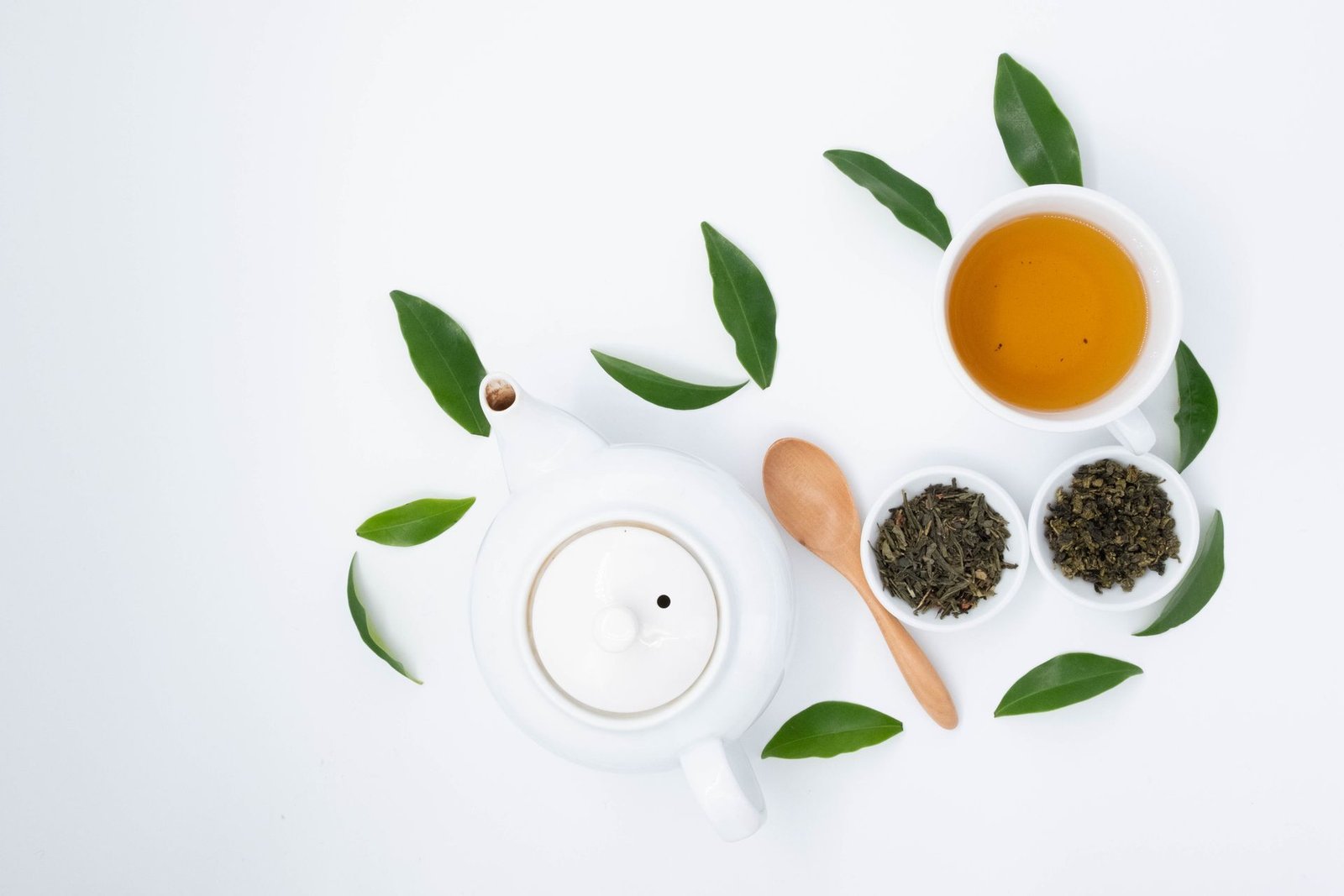
Green tea is the unfermented leaf of Camellia sinensis. Its main active polyphenol is epigallocatechin-3-gallate, usually shortened to EGCG. Laboratory work on human sebaceous cells suggests EGCG acts on several acne processes at once: it reduces sebum production through the AMPK-SREBP-1 signalling pathway, dampens inflammatory signalling through the NF-kB and AP-1 pathways, is toxic to sebocytes, and reduces the viability of Cutibacterium acnes, the bacterium involved in inflamed lesions. In products it appears as an EGCG solution at 1 to 5 percent, as a 2 percent green tea lotion in one study, and as unquantified “green tea extract” in cleansers and serums. Drinking the tea is a different exposure from putting it on skin, and the two have been studied separately.
What the evidence actually shows
The guideline’s complementary and alternative therapies statement reads: “Available evidence is insufficient to develop a recommendation on the use of topical tea tree oil, topical green tea, topical witch hazel, oral pantothenic acid, oral or topical zinc, oral or topical niacinamide for acne treatment.” Green tea is named there, not in the separate topical-agent statement that covers glycolic acid.
A 2021 meta-analysis in Phytotherapy Research pooled five randomised controlled studies, 125 people on green tea extract and 122 controls. Overall, green tea extract reduced inflammatory lesion counts by a mean of 9.38 lesions (95% CI -14.13 to -4.63). Split by route, topical application accounted for almost all of it: -11.39 (95% CI -15.91 to -6.86) for topical against -1.40 (95% CI -2.50 to -0.30) for oral. For non-inflammatory lesions the overall pooled result was not significant (-21.65, 95% CI -47.52 to 4.22), though the topical subgroup was (-32.44, 95% CI -39.27 to -25.62) and the oral subgroup was not meaningful. The authors concluded that topical application looks beneficial without significant adverse events, and that further high-quality trials are warranted.
The strongest single study is an eight-week randomised split-face trial in which 35 participants applied EGCG at 1 or 5 percent to one side of the face and a vehicle to the other. On the 1 percent side, mean non-inflammatory lesions fell from 53.8 to 15.6 and mean inflammatory lesions from 10.0 to 1.1.
The guideline landed on insufficient because that is the entire base: a few small, short trials, no standard formulation between them, and no comparison against benzoyl peroxide, a retinoid or an antibiotic.
How it is actually used
If you try it, topical is the route with the signal; the pooled oral effect was too small to be of practical use. The trials used defined EGCG concentrations, typically 1 to 5 percent, or a 2 percent green tea lotion, applied to the face twice daily for six to eight weeks. Almost no retail product states its EGCG content, so you cannot match what was actually tested, and EGCG degrades with light and air. Give any topical eight to twelve weeks before judging it. Drinking green tea is not the intervention that produced these results. Treat it as an optional extra alongside benzoyl peroxide or a topical retinoid, not as a replacement for either.
Safety and who should avoid it
Topical green tea was well tolerated in the trials, which reported no significant adverse events. Expect the ordinary possibilities of mild stinging or dryness, and bear in mind these studies were small enough that an uncommon reaction would not have shown up. Concentrated oral green tea extract is a different matter: the NIH LiverTox database rates it as a well-established cause of clinically apparent liver injury, typically an acute hepatitis-like picture arising within one to six months, and describes the injury as idiosyncratic rather than dose-dependent. Drinking green tea itself has not been linked to liver injury. Topical use in pregnancy has not been studied; discuss it with your clinician.
Commonly repeated: Topical green tea cuts acne lesions by nearly 60 percent. What the evidence actually shows: that figure comes from a single open-label study of 20 patients applying a 2 percent green tea lotion twice daily for six weeks, in which total lesion count fell from 24 to 10. There was no control group and no blinding, so the design cannot separate the lotion from the natural course of acne or from the simple act of applying something twice a day. The better-controlled topical EGCG work is genuinely promising, but it amounts to a handful of small trials, and the 2024 AAD guideline names topical green tea in its insufficient-evidence statement for complementary and alternative therapies.
Sources
- Reynolds RV, Yeung H, Cheng CE, et al. Guidelines of care for the management of acne vulgaris, J Am Acad Dermatol 2024;90(5):1006.e1-1006.e30
- Kim S, Park TH, Kim WI, et al. The effects of green tea on acne vulgaris: a systematic review and meta-analysis of randomized clinical trials, Phytother Res 2021;35(1):374-383
- Yoon JY, Kwon HH, Min SU, Thiboutot DM, Suh DH. Epigallocatechin-3-gallate improves acne in humans by modulating intracellular molecular targets and inhibiting P. acnes, J Invest Dermatol 2013;133(2):429-440
- Elsaie ML, Abdelhamid MF, Elsaaiee LT, Emam HM. The efficacy of topical 2% green tea lotion in mild-to-moderate acne vulgaris, J Drugs Dermatol 2009;8(4):358
- LiverTox: Clinical and Research Information on Drug-Induced Liver Injury — Green Tea, NIDDK/NCBI Bookshelf
Keep reading
See where this sits against every other acne treatment on the acne treatment evidence map, or check how it combines with another ingredient in the ingredient combination checker. For the guideline’s own wording on this, see the 2024 AAD guideline, recommendation by recommendation.
Not medical advice
This page reports what the published evidence says about a treatment. It is not a treatment plan and it cannot account for your skin, your other medications or your medical history. Nothing here has been reviewed by a clinician; see our editorial policy for what that means. Talk to a clinician before starting or stopping any prescription treatment.
Cite this page: TipsForAcne, “Green Tea for Acne: Does Topical EGCG Help?”, tipsforacne.com/green-tea-for-acne/ (updated ). Free to quote with attribution and a link to this page.
Source links on this site are checked every month; last check . How sources are checked.