| Where the guideline stands | Strong recommendation (2024 AAD guideline), on moderate certainty evidence |
| Availability | Prescription |
| How long before you judge it | 8–12 weeks |
| Pregnancy | Avoid: tetracycline class. |
| Sources behind this page | 8, every one linked at the bottom |
What it is
Minocycline is a tetracycline-class antibiotic that has been taken by mouth for acne for decades. Amzeeq is minocycline 4% in a topical foam, approved by the FDA in October 2019, the first topical formulation of minocycline approved for any condition. It is indicated for inflammatory lesions of non-nodular moderate to severe acne vulgaris in patients 9 years of age and older. Tetracyclines work in acne in two ways at once: they suppress Cutibacterium acnes, and they damp down inflammation independently of that antibacterial effect. The point of the foam is to deliver the drug into the follicle while keeping systemic exposure low; the label notes that low systemic absorption is expected after topical use.
What the evidence actually shows
The registrational programme was three 12-week randomized, double-blind, vehicle-controlled trials enrolling 2,418 subjects aged 9 and over. Two of them (Gold LS et al., JAAD 2019; Study 04 n=466, Study 05 n=495) had co-primary endpoints of change in inflammatory lesion count and Investigator’s Global Assessment success at week 12. Minocycline foam significantly out-performed vehicle on inflammatory lesions in both studies, but reached IGA significance in only one of the two individually; the pooled analysis was significant for both endpoints.
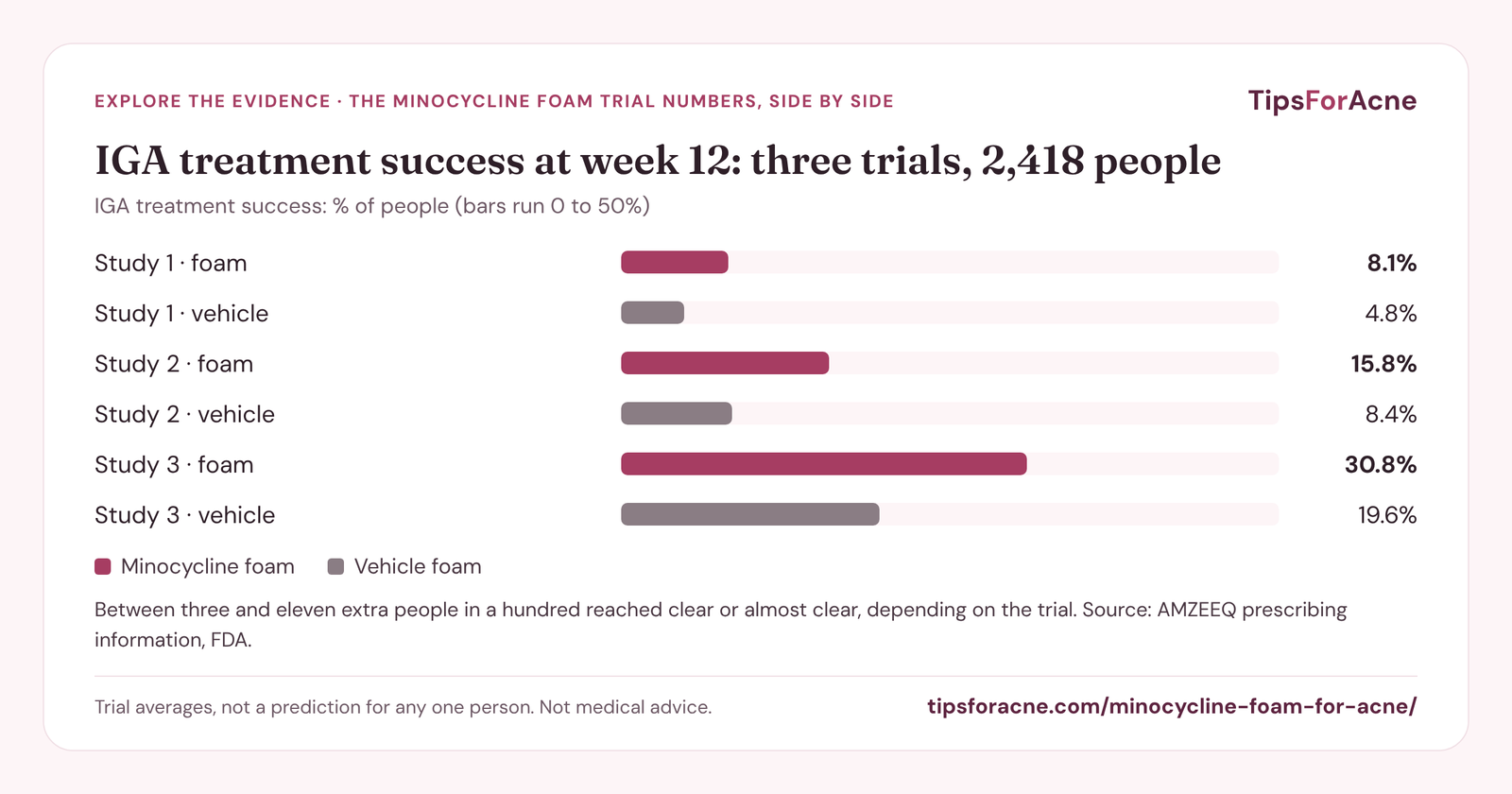
The label sets out all three trials side by side, and the numbers are worth reading plainly. IGA treatment success at week 12 was 8.1% versus 4.8% on vehicle in study 1, 15.8% versus 8.4% in study 2, and 30.8% versus 19.6% in study 3. Mean inflammatory lesion counts fell by 14.0, 13.7 and 16.4 on the foam against 11.2, 10.5 and 12.7 on vehicle. The direction is consistent across all three trials. The size of the advantage is a few lesions, and depending on the trial somewhere between three and eleven extra people in a hundred reaching clear or almost clear.
There are no published trials comparing minocycline foam with benzoyl peroxide, a topical retinoid or topical clindamycin, so nothing supports a claim that it works better than cheaper options. That is part of why the guideline graded the class rather than the drug. Recommendation 1.4 reads “For patients with acne, we recommend topical antibiotics”, a strong recommendation on moderate-certainty evidence, with the explicit remark that topical antibiotic monotherapy is not recommended, because of resistance. NICE’s network meta-analysis for mild-to-moderate acne went further still, finding that topical clindamycin monotherapy showed no evidence of effect versus placebo.
Explore the evidence
The minocycline foam trial numbers, side by side
IGA treatment success at week 12: three trials, 2,418 people
IGA treatment success: % of people (bars run 0 to 50%)
Minocycline foamVehicle foam
Between three and eleven extra people in a hundred reached clear or almost clear, depending on the trial. Source: AMZEEQ prescribing information, FDA.
Average drop in inflammatory lesion count at week 12
Inflammatory lesions: average drop in count (bars run 0 to 20)
Minocycline foamVehicle foam
These are counts of spots, not percentages: the advantage is a few lesions. No published trial compares the foam with benzoyl peroxide, a retinoid or topical clindamycin.
Trial averages, not a prediction for any one person. Not medical advice.
How it is actually used
Amzeeq is applied once daily, about a cherry-sized amount, gently rubbed into the affected areas; the label asks you not to bathe, shower or swim for an hour afterwards. Twelve weeks is the right window before judging it, because that is how long the trials ran. The guideline’s stewardship point applies: do not use it on its own. Pairing a topical antibiotic with benzoyl peroxide is what keeps resistance down, and fixed-dose antibiotic-plus-benzoyl-peroxide products carry their own strong recommendation. Cost is the practical obstacle. There is no FDA-approved generic, and the formulation patents run to at least 2030, so this is a brand-price product in a category full of cheap, well-evidenced alternatives.
Safety and who should avoid it
The commonest reported adverse event in the trials was headache, at 3% versus 2% on vehicle. Local tolerability at week 12 was mostly mild: erythema 14.2% mild and 1.5% moderate, hyperpigmentation 12.4% mild and 2.8% moderate, dryness 6.8% mild, itching 5.1% mild. The label carries the full tetracycline class warnings: fetal harm, permanent tooth discoloration if used under age 8, C. difficile-associated diarrhoea, hepatotoxicity, intracranial hypertension, autoimmune syndromes and photosensitivity, even though systemic absorption from the foam is expected to be low. Avoid in pregnancy; the label states that breastfeeding is not recommended during treatment. The propellant is flammable. Long-term safety beyond the trial period is not well characterised.
Commonly repeated: the AAD “strongly recommends” minocycline foam for acne. What the evidence actually shows: the 2024 guideline’s strong, moderate-certainty recommendation (1.4) is for topical antibiotics as a class. No individual topical antibiotic is graded on its own, and that same recommendation carries the remark that topical antibiotic monotherapy is not recommended.
Sources
- Reynolds RV, Yeung H, Cheng CE, et al. Guidelines of care for the management of acne vulgaris. J Am Acad Dermatol 2024;90(5):1006.e1-1006.e30
- Guideline Central. 2024 AAD Acne Vulgaris Clinical Guideline Summary (verbatim recommendation wording, strength and certainty ratings; recommendations are unnumbered on this page)
- DailyMed. AMZEEQ (minocycline) aerosol, foam — full prescribing information
- FDA. AMZEEQ (minocycline) topical foam, 4% prescribing information, NDA 212379
- Gold LS, Dhawan S, Weiss J, et al. A novel topical minocycline foam for the treatment of moderate-to-severe acne vulgaris: results of 2 randomized, double-blind, phase 3 studies. J Am Acad Dermatol 2019;80(1)
- NICE. Management options for mild to moderate acne — network meta-analyses (NG198 evidence review)
- Drugs.com. Amzeeq (minocycline) FDA approval history
- Drugs.com. Generic Amzeeq availability and patent expiry
Keep reading
See where this sits against every other acne treatment on the acne treatment evidence map, or check how it combines with another ingredient in the ingredient combination checker. For the guideline’s own wording on this, see the 2024 AAD guideline, recommendation by recommendation.
Not medical advice
This page reports what the published evidence says about a treatment. It is not a treatment plan and it cannot account for your skin, your other medications or your medical history. Nothing here has been reviewed by a clinician; see our editorial policy for what that means. Talk to a clinician before starting or stopping any prescription treatment.
Cite this page: TipsForAcne, “Minocycline Foam (Amzeeq) for Acne: How Well Does It Work?”, tipsforacne.com/minocycline-foam-for-acne/ (updated ). Free to quote with attribution and a link to this page.
Source links on this site are checked every month; last check . How sources are checked.