| Where the guideline stands | Insufficient evidence to recommend either way |
| Availability | In clinic |
| How long before you judge it | A series of sessions |
| Pregnancy | Discuss with your clinician. |
| Sources behind this page | 7, every one linked at the bottom |
What it is
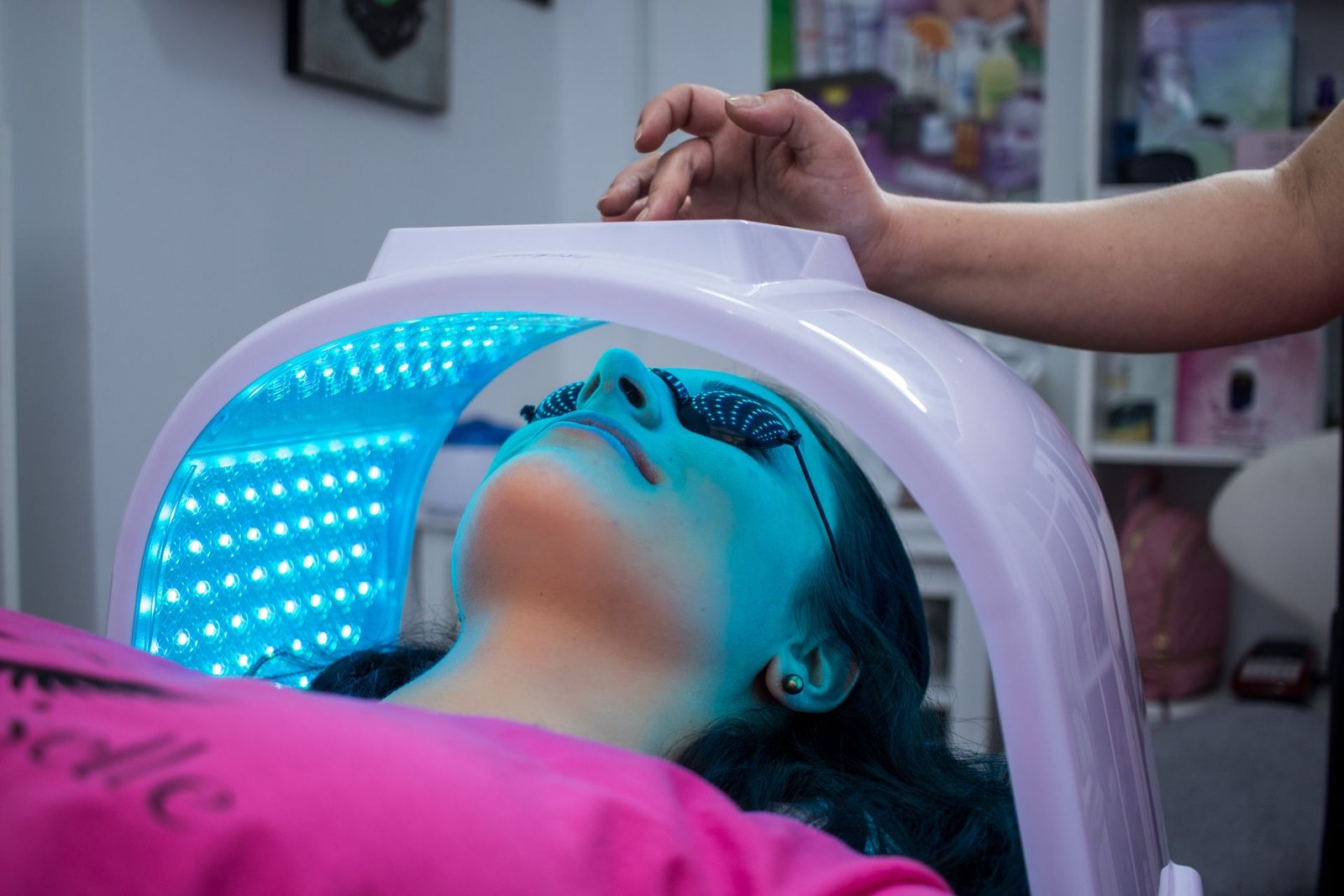
Photodynamic therapy is a two-step procedure. A photosensitising drug is applied to the skin and left to soak in, usually 5-aminolevulinic acid (ALA) or its ester methyl aminolevulinate (MAL), for anything from twenty minutes to several hours. Both are precursors that skin cells convert into protoporphyrin IX, which accumulates preferentially in sebaceous glands and in Cutibacterium acnes. The treated area is then illuminated, usually with blue light, red light, a pulsed dye laser or intense pulsed light. The absorbed light excites the protoporphyrin and generates reactive oxygen species that damage the gland and the bacteria. The intention is a lasting reduction in sebum production, closer in ambition to isotretinoin than to a topical.
What the evidence actually shows
The guideline’s physical-modalities statement names it directly: “Available evidence is insufficient to develop a recommendation on the use of … photodynamic therapy with aminolevulinic acid for the treatment of acne.”
There is no shortage of studies. A 2024 systematic review screened 1122 records and included 82 studies covering 4340 patients, of which 25 were randomised controlled trials. Half the patients received ALA-PDT and a tenth MAL-PDT. Average follow-up after study completion was three months, ranging from two weeks to thirteen months. The authors summarised the entire body of work as showing “a partial clinical response”, and called for standardised protocols and direct comparisons against other acne treatments.
The vehicle-controlled data are less flattering. The 2016 Cochrane review found that 20% ALA-PDT activated by blue light showed little or no difference in effectiveness compared with vehicle plus blue light, and that across three trials in 360 participants, MAL-PDT activated by red light was no different from placebo cream plus red light. When the light is held constant and only the drug varies, the drug’s own contribution becomes hard to see.
Individual trials show the same pattern. In a randomised, controlled, split-face trial of 44 patients published in the Journal of Cosmetic Dermatology in 2010, ALA was applied for 60 to 90 minutes before three pulsed dye laser sessions on one side of the face. Global acne severity improved on both sides, significantly more on the treated side, but only 30% of patients were judged responders on inflammatory lesion counts, and 7% on non-inflammatory counts. A 2017 split-face study comparing ALA with red light against ALA with intense pulsed light enrolled twelve patients and had no vehicle arm at all. That is the typical size and design of this literature, and it is why enthusiasm ran ahead of the evidence.
How it is actually used
This is an in-clinic procedure, usually a short course of sessions a few weeks apart, priced per session and paid out of pocket. Aetna’s medical policy, as one example, lists blue light with topical aminolevulinic acid among treatments it considers experimental, investigational or unproven for acne. The ALA product itself is used off-label: the Levulan Kerastick label is approved for minimally to moderately thick actinic keratoses of the face, scalp or upper extremities, not for acne. Protocols vary enormously between clinics in incubation time, light source, energy and number of sessions, with no agreed standard, which is a large part of why the trial results cannot be pooled meaningfully. Plan for downtime afterwards. If a clinic quotes a course without discussing the photosensitivity period, that is a bad sign.
Safety and who should avoid it
The side-effect burden is the best-characterised thing about acne PDT. In the 2017 split-face study, pain during ALA with red light was rated 5 out of 10 on a numerical scale, against 2.5 for intense pulsed light; a third of participants had a transient acne flare, and 17% developed hyperpigmentation on the red light side. Erythema, swelling, oozing and crusting are routine. Photosensitivity is the part people underestimate: the Levulan label instructs patients to avoid sunlight and bright indoor light at the treated site for 40 hours, and states plainly that sunscreens will not protect against the reaction. Pigment change is a particular concern in darker skin. Long-term and pregnancy data are absent.
Commonly repeated: Photodynamic therapy is “isotretinoin without the pills”, a one-off way to shut sebaceous glands down for good. What the evidence actually shows: No trial has demonstrated that. The vehicle-controlled comparisons in the Cochrane review found ALA-PDT and MAL-PDT performing much like the light alone; follow-up across the published literature averages about three months; and the AAD work group concluded the evidence was insufficient to recommend it either way.
Sources
- Reynolds RV, Yeung H, Cheng CE, et al. Guidelines of care for the management of acne vulgaris, J Am Acad Dermatol 2024
- Qureshi S, Rehan Z, Ao A, Mukovozov I. Photodynamic Therapy in Acne Vulgaris: A Systematic Review, J Cutan Med Surg 2024
- Barbaric J, Abbott R, Posadzki P, et al. Light therapies for acne, Cochrane Database of Systematic Reviews 2016
- Orringer JS, Sachs DL, Bailey E, et al. Photodynamic therapy for acne vulgaris: a randomized, controlled, split-face clinical trial of topical aminolevulinic acid and pulsed dye laser therapy, J Cosmet Dermatol 2010;9(1):28-34
- Zhang L, Wu Y, Zhang Y, et al. Topical 5-aminolevulinic photodynamic therapy with red light vs intense pulsed light for the treatment of acne vulgaris, Dermatoendocrinol 2017
- DailyMed: LEVULAN KERASTICK (aminolevulinic acid hydrochloride) label
- Aetna Clinical Policy Bulletin 0656: Phototherapy for Acne
Keep reading
See where this sits against every other acne treatment on the acne treatment evidence map, or check how it combines with another ingredient in the ingredient combination checker. For the guideline’s own wording on this, see the 2024 AAD guideline, recommendation by recommendation.
Not medical advice
This page reports what the published evidence says about a treatment. It is not a treatment plan and it cannot account for your skin, your other medications or your medical history. Nothing here has been reviewed by a clinician; see our editorial policy for what that means. Talk to a clinician before starting or stopping any prescription treatment.
Cite this page: TipsForAcne, “Photodynamic Therapy for Acne: What the Trials Show”, tipsforacne.com/photodynamic-therapy-for-acne/ (updated ). Free to quote with attribution and a link to this page.
Source links on this site are checked every month; last check . How sources are checked.