| Where the guideline stands | Insufficient evidence to recommend either way |
| Availability | Over the counter |
| How long before you judge it | Unclear |
| Pregnancy | Discuss with your clinician. |
| Sources behind this page | 7, every one linked at the bottom |
What it is
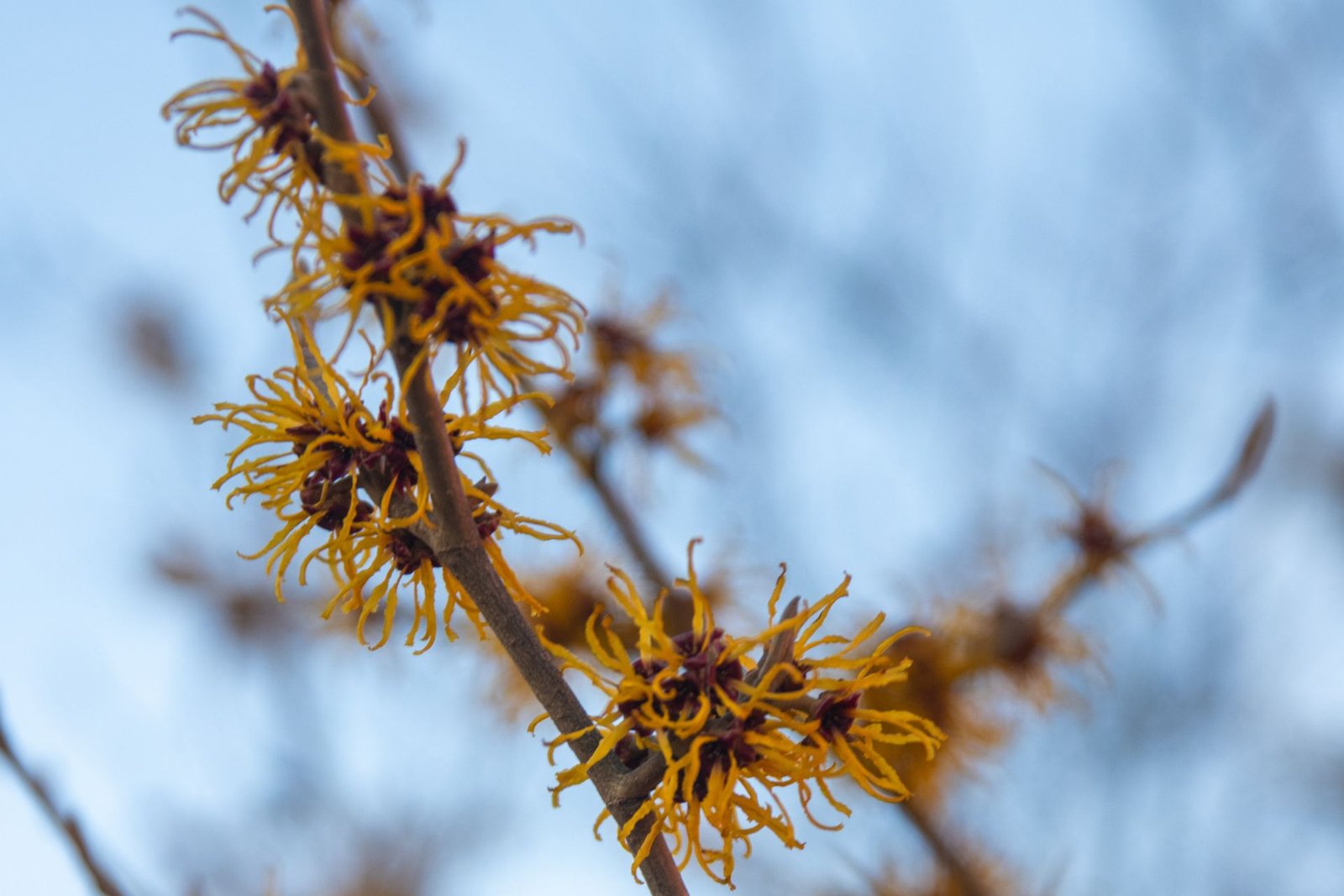
Witch hazel is a distillate or extract made from the bark and leaves of Hamamelis virginiana, a North American shrub. Its characteristic constituents are tannins, chiefly hamamelitannin and the proanthocyanidins, which bind and precipitate proteins at the skin surface. That is what an astringent does: it makes tissue contract and feel tightened, and it takes the shine off oily skin for a while. Most of what is sold in drugstores is a distillate preserved with alcohol, and the alcohol contributes a large part of the immediate degreasing sensation people attribute to the plant. In the US it is regulated under 21 CFR part 347 as an over-the-counter astringent active ingredient in skin protectant products, where the permitted claim is relief of minor skin irritation from insect bites, minor cuts or minor scrapes.
What the evidence actually shows
Start with what does not exist. I could find no randomised controlled trial of witch hazel in acne. It does not appear in either of the two NICE 2021 acne excluded-study appendices I checked, so there was not even a badly designed witch hazel trial to reject. It is not in the FDA’s over-the-counter acne monograph, M006, which permits benzoyl peroxide, salicylic acid, sulfur and resorcinol-with-sulfur and nothing else. Its regulatory home is the astringent section of the skin protectant monograph, and the labelling permitted there says nothing about acne.
Add the guideline itself as a source: {“label”:”Reynolds RV, Yeung H, Cheng CE, et al. Guidelines of care for the management of acne vulgaris (complementary and alternative therapies insufficient-evidence statement), J Am Acad Dermatol 2024;90(5):1006.e1-1006.e30″,”url”:”https://pubmed.ncbi.nlm.nih.gov/38300170/”}. Correct source 0’s label to ‘Updated guidelines for the management of acne (summary; states evidence was insufficient for alternative therapies as a category, does not name individual ingredients)’ and source 1’s label to ‘(quotes the guideline’s topical-agent insufficient-evidence statement verbatim)’. That is a finding of insufficient evidence, which is not the same as a finding that it does not work. The work group looked and could not make a recommendation either way.
The closest thing to acne-specific data is laboratory work. Sangiovanni and colleagues, in Antioxidants in 2022, tested a glycolic extract of Hamamelis virginiana bark on cultured human keratinocytes. The extract reduced Cutibacterium acnes-induced release of the inflammatory signal IL-6, partly by blocking NF-kB activation, and the effect tracked with proanthocyanidin content rather than hamamelitannin. Crucially, the same study found the extract had no antibacterial and no antibiofilm activity against C. acnes at all. That is an interesting finding about inflammation in a dish. It is not evidence that dabbing witch hazel on a spot clears it, and the authors did not claim otherwise; they called for further investigation.
The honest summary is not that witch hazel does not work. It is that after decades on the shelf, nobody has run the study that would tell us.
How it is actually used
There is nothing here to dose, because there is no established acne regimen for it. If you like how it feels as a toner, that is a cosmetic preference rather than a treatment, and there is no harm in keeping it on that basis. What matters is that it should not occupy the slot in your routine that an actual acne treatment would fill. Alcohol-based distillates are drying, and a stripped, irritated barrier is one of the commonest reasons people abandon the benzoyl peroxide or topical retinoid that would genuinely have helped. If witch hazel feels like it is doing something and that feeling is what keeps you from starting a treatment the guideline actually recommends, it is costing you. Salicylic acid is in the same aisle, has been tested, and has a conditional AAD recommendation on low-certainty evidence.
Safety and who should avoid it
Witch hazel has a long consumer safety record at the strengths sold, and US regulators permit it over the counter as an astringent for minor skin irritation. The practical problem is drying and irritation, mostly from the alcohol in typical distillates, and that matters more than it sounds when it is layered onto a retinoid or benzoyl peroxide. Beyond that, honesty requires admitting how thin the record is. There is no acne-specific safety data, no pregnancy data for acne use, and no long-term follow-up, because the trials that would have produced them were never run. How often it provokes allergic contact reactions is not something I found reliable data on. If you are pregnant or your skin is already reactive, ask a clinician.
Commonly repeated: Witch hazel is antibacterial and kills the bacteria that cause acne. What the evidence actually shows: A 2022 laboratory study in Antioxidants that tested a Hamamelis virginiana bark extract directly against Cutibacterium acnes found it had no antibacterial and no antibiofilm activity against the organism. What it did do, in cultured skin cells, was damp down one inflammatory signal. That is a different claim, it was made in a dish rather than on a person, and it has never been followed up in a clinical trial.
Sources
- Reynolds RV, Yeung H, Cheng CE, et al. Guidelines of care for the management of acne vulgaris. J Am Acad Dermatol 2024;90(5):1006.e1-1006.e30
- American Academy of Dermatology. Updated guidelines for the management of acne (summary of Reynolds RV et al., J Am Acad Dermatol 2024), including the insufficient-evidence statement on alternative and plant-based therapies
- Inside the 2024 AAD Acne Guidelines: New Therapies Join Old Standbys (quotes the guideline’s named insufficient-evidence ingredients), Dermatology News/MDedge 2024
- Sangiovanni E, Piazza S, Martinelli G, et al. Anti-Inflammatory and Anti-Acne Effects of Hamamelis virginiana Bark in Human Keratinocytes, Antioxidants 2022;11(6):1119
- US eCFR. 21 CFR Part 347, Skin Protectant Drug Products for Over-the-Counter Human Use (witch hazel listed as an astringent active ingredient)
- US FDA. OTC Monograph M006: Topical Acne Drug Products for Over-the-Counter Human Use, 2021 (witch hazel is not a permitted acne active)
- NICE NG198 evidence review F. Management options for mild to moderate acne – excluded studies appendix (no witch hazel trials listed), 2021
Keep reading
See where this sits against every other acne treatment on the acne treatment evidence map, or check how it combines with another ingredient in the ingredient combination checker. For the guideline’s own wording on this, see the 2024 AAD guideline, recommendation by recommendation.
Not medical advice
This page reports what the published evidence says about a treatment. It is not a treatment plan and it cannot account for your skin, your other medications or your medical history. Nothing here has been reviewed by a clinician; see our editorial policy for what that means. Talk to a clinician before starting or stopping any prescription treatment.
Cite this page: TipsForAcne, “Witch Hazel for Acne: Does It Actually Do Anything?”, tipsforacne.com/witch-hazel-for-acne/ (updated ). Free to quote with attribution and a link to this page.
Source links on this site are checked every month; last check . How sources are checked.