| Where the guideline stands | Strong recommendation (2024 AAD guideline), on moderate certainty evidence |
| Availability | Prescription |
| How long before you judge it | 8–12 weeks |
| Pregnancy | Discuss with your clinician. |
| Sources behind this page | 8, every one linked at the bottom |
What it is
Dapsone is a sulfone, first used in the 1940s against leprosy and later for dermatitis herpetiformis. Aczone is dapsone in a topical gel: the 5% twice-daily version was approved in July 2005 and the 7.5% once-daily version in February 2016. The 7.5% gel is indicated for the topical treatment of acne vulgaris in patients 9 years of age and older. What it does in acne is genuinely unsettled: the prescribing information states outright that “the mechanism of action of dapsone gel in treating acne vulgaris is not known.” It is usually described as both antibacterial and anti-inflammatory, and in practice it is reached for mainly for inflammatory papules and pustules rather than comedones.
What the evidence actually shows
Two sets of vehicle-controlled trials underpin the two strengths, and both are unusually large.
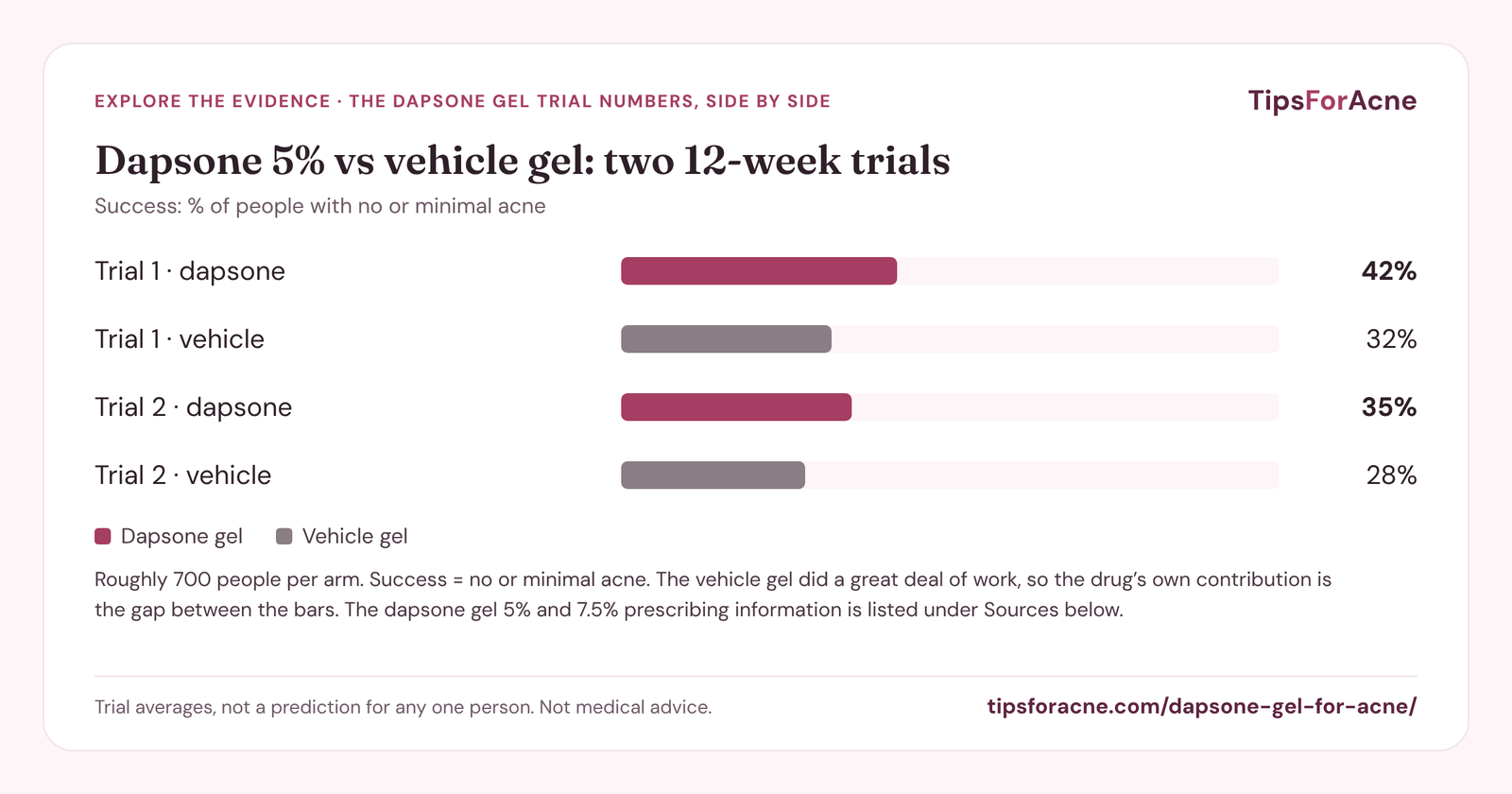
For the 5% twice-daily gel, two 12-week trials randomized roughly 700 people per arm. Success, defined as no or minimal acne, was 42% versus 32% on vehicle in one trial and 35% versus 28% in the other. Inflammatory lesions fell by 46% versus 42% and 48% versus 40%; non-inflammatory lesions by 31% versus 24% and 30% versus 21%.
For the 7.5% once-daily gel, two identically designed multicentre trials randomized 4,340 subjects. Global Acne Assessment Score success was 30% versus 21% on vehicle in both trials. Inflammatory lesions fell by 56% versus 49% and 54% versus 48%; non-inflammatory lesions by 45% versus 39% and 46% versus 41%. A pooled publication of those two trials (Thiboutot et al., J Clin Aesthet Dermatol 2016) reports 29.8% versus 21.1% success, with inflammatory lesions down 54.6% versus 48.1%.
Two things stand out. First, the vehicle does a great deal of work: roughly a fifth to a third of people on gel base alone met the success definition, so the drug’s own contribution is the gap between the columns, not the headline number. Second, the 7.5% once-daily formulation was never tested head to head against 5% twice daily, so “stronger” here means a higher concentration and a simpler routine, not demonstrated superiority.
The guideline handles dapsone inside recommendation 1.4, “For patients with acne, we recommend topical antibiotics” (strong, on moderate-certainty evidence) rather than grading it separately, and attaches the remark that topical antibiotic monotherapy is not recommended. Strength and certainty are separate axes: a strong recommendation for the class is not the same as high-certainty evidence for this drug.
Explore the evidence
The dapsone gel trial numbers, side by side
Dapsone 5% vs vehicle gel: two 12-week trials
Success: % of people with no or minimal acne
Inflammatory lesions cut: % drop in inflammatory lesions
Non-inflammatory lesions cut: % drop in non-inflammatory lesions
Dapsone gelVehicle gel
Roughly 700 people per arm. Success = no or minimal acne. The vehicle gel did a great deal of work, so the drug’s own contribution is the gap between the bars. The dapsone gel 5% and 7.5% prescribing information is listed under Sources below.
Dapsone 7.5% vs vehicle gel: two trials, 4,340 people
Success: % of people reaching success
Inflammatory lesions cut: % drop in inflammatory lesions
Non-inflammatory lesions cut: % drop in non-inflammatory lesions
Dapsone gelVehicle gel
Success = Global Acne Assessment Score success. Pooled figures: Thiboutot et al., J Clin Aesthet Dermatol 2016 (no pooled figure for non-inflammatory lesions on this page). 7.5% was never tested head to head against 5%, so “stronger” means a higher concentration and a simpler routine, not proven superiority.
Trial averages, not a prediction for any one person. Not medical advice.
How it is actually used
A pea-sized amount, once daily for the 7.5% gel and twice daily for the 5%, in a thin layer over the whole face rather than dabbed on individual spots. The label says to reassess if there is no improvement after 12 weeks, which is a fair minimum before judging it. Because the guideline warns against topical antibiotic monotherapy, dapsone is normally combined with benzoyl peroxide or a retinoid, but applying benzoyl peroxide directly on top of freshly applied dapsone causes a temporary yellow-to-orange discoloration of skin and facial hair, so people commonly separate the two, one in the morning and one at night. That workaround is a practical convention rather than a labelled instruction.
Safety and who should avoid it
Adverse events in the 7.5% trials were essentially the same as vehicle; application site dryness (1.1%) and pruritus (0.9%) were the most common. The 5% label lists no contraindications at all. Methemoglobinemia has been reported after marketing, including cases resulting in hospitalisation, and the label advises avoiding dapsone gel in people with congenital or idiopathic methemoglobinemia. Some G6PD-deficient users of the 5% gel showed laboratory changes suggestive of hemolysis, but no clinically relevant hemolysis or anemia. Human pregnancy data are absent; oral dapsone was embryocidal in animals at systemic exposures more than 250 times those from the gel. Pregnancy and breastfeeding are a conversation to have with a clinician.
Commonly repeated: you need a G6PD test before starting dapsone gel, the way you would with oral dapsone. What the evidence actually shows: no screening is required. A randomized, vehicle-controlled crossover study in 64 G6PD-deficient patients (Piette et al., Arch Dermatol 2008) found no clinical or laboratory evidence of drug-induced hemolytic anemia; the FDA label carries no screening requirement, and a 2007 labelling supplement removed the earlier blood-monitoring language; and the 2024 AAD guideline does not call for G6PD testing before topical dapsone.
Sources
- Reynolds RV, Yeung H, Cheng CE, et al. Guidelines of care for the management of acne vulgaris. J Am Acad Dermatol 2024;90(5):1006.e1-1006.e30
- Guideline Central. 2024 AAD Acne Vulgaris Clinical Guideline Summary (verbatim recommendation wording, strength and certainty ratings; recommendations are unnumbered on this page)
- DailyMed. ACZONE (dapsone) gel, 7.5% — full prescribing information
- DailyMed. DAPSONE gel, 5% — full prescribing information
- Piette WW, Taylor S, Pariser D, et al. Hematologic safety of dapsone gel, 5%, for topical treatment of acne vulgaris. Arch Dermatol 2008;144(12):1564-1570
- Thiboutot DM, Kircik L, McMichael A, et al. Efficacy, safety, and dermal tolerability of dapsone gel, 7.5% in patients with moderate acne vulgaris: a pooled analysis of two phase 3 trials. J Clin Aesthet Dermatol 2016;9(10):18-27
- Dubina MI, Fleischer AB Jr. Interaction of topical sulfacetamide and topical dapsone with benzoyl peroxide. Arch Dermatol 2009;145(9):1027-1029
- Drugs.com. Aczone (dapsone) FDA approval history
Keep reading
See where this sits against every other acne treatment on the acne treatment evidence map, or check how it combines with another ingredient in the ingredient combination checker. For the guideline’s own wording on this, see the 2024 AAD guideline, recommendation by recommendation.
Not medical advice
This page reports what the published evidence says about a treatment. It is not a treatment plan and it cannot account for your skin, your other medications or your medical history. Nothing here has been reviewed by a clinician; see our editorial policy for what that means. Talk to a clinician before starting or stopping any prescription treatment.
Cite this page: TipsForAcne, “Dapsone Gel (Aczone) for Acne: Evidence and Side Effects”, tipsforacne.com/dapsone-gel-for-acne/ (updated ). Free to quote with attribution and a link to this page.
Source links on this site are checked every month; last check . How sources are checked.