| Where the guideline stands | Not addressed by the guideline |
| Availability | Prescription |
| How long before you judge it | 12 weeks, the length of every trial |
| Pregnancy | Not contraindicated on the FDA label, but human data are insufficient to judge the risk. A conversation with your clinician. |
| Sources behind this page | 7, every one linked at the bottom |
What it is
Cabtreo is a fixed-dose gel combining clindamycin phosphate 1.2%, adapalene 0.15% and benzoyl peroxide 3.1%. The FDA approved it on 20 October 2023 for the topical treatment of acne vulgaris in adult and paediatric patients 12 years of age and older, the first fixed-dose triple-combination acne product. The logic is that each component attacks acne differently: clindamycin is a lincosamide antibacterial, adapalene is a retinoid that binds retinoic acid nuclear receptors and normalises how skin cells differentiate and shed, and benzoyl peroxide is an oxidising agent that is bactericidal and keratolytic. Benzoyl peroxide also does stewardship work, suppressing the emergence of clindamycin-resistant bacteria, which is why antibiotic-plus-benzoyl-peroxide pairings exist in the first place.
What the evidence actually shows
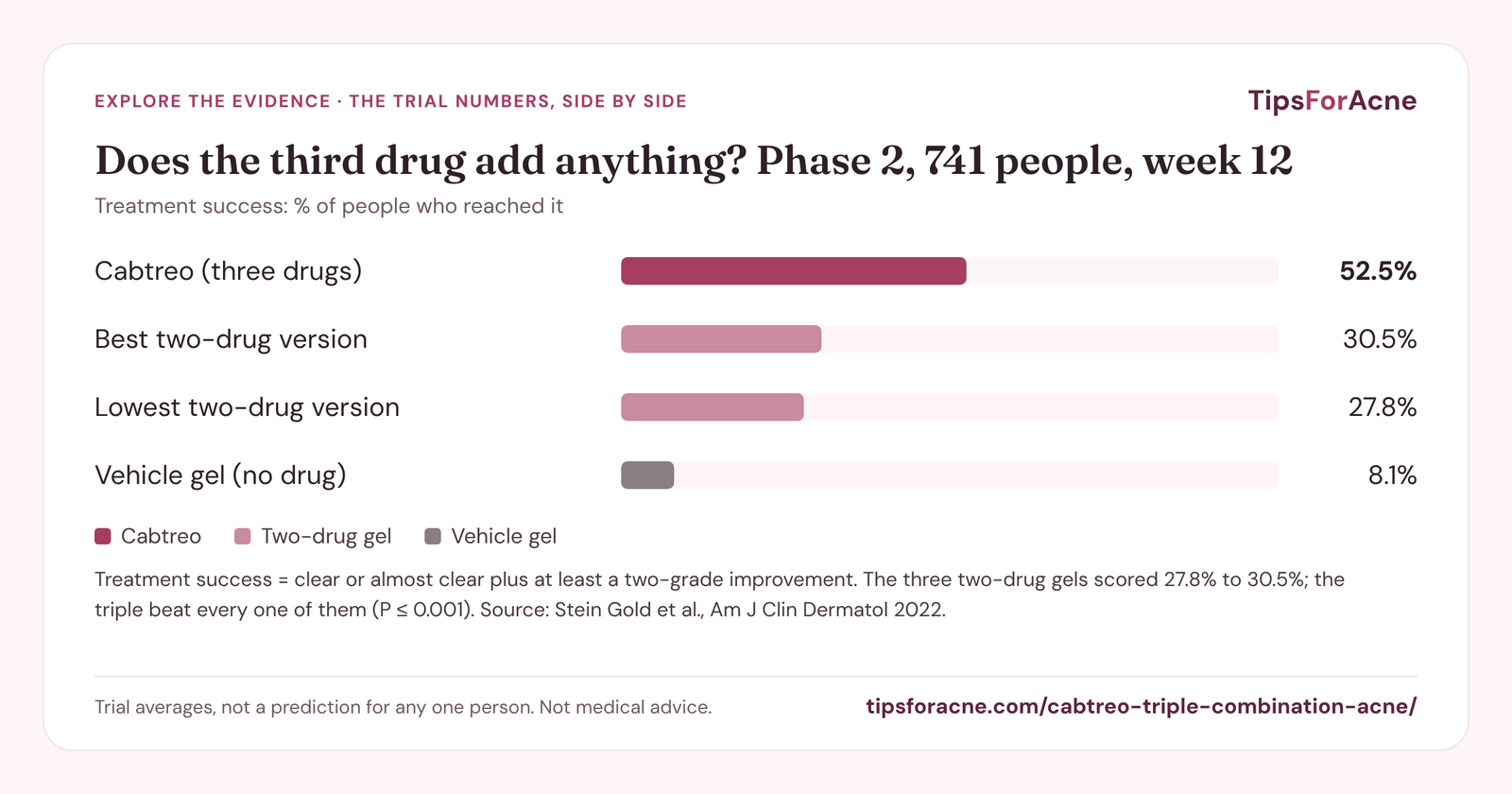
The interesting study is the phase 2, because it is the only one that asks whether three drugs beat two. Stein Gold and colleagues (Am J Clin Dermatol 2022;23:93-104) randomized 741 people aged 9 and over with moderate-to-severe acne to the triple gel, to each of the three possible two-drug versions of it, or to vehicle, for 12 weeks. Treatment success (clear or almost clear plus at least a two-grade improvement) was 52.5% on the triple, 27.8% to 30.5% across the three dyads, and 8.1% on vehicle. The triple beat every dyad on treatment success (P ≤ 0.001) and on lesion counts (P < 0.05). That is the strongest single piece of evidence for the product.
The two phase 3 trials were vehicle-controlled only, with no active comparator. They randomized 183 and 180 subjects 2:1. Treatment success at week 12 was 49.6% versus 24.9% in one and 50.5% versus 20.5% in the other. Inflammatory lesions fell 75.7% versus 59.6% and 80.1% versus 56.2%; non-inflammatory lesions 72.7% versus 47.6% and 73.3% versus 49.0%. A pooled analysis (Kircik et al., Dermatol Ther 2024;14:1211-1227) reports 50.0% versus 22.6% success and inflammatory lesions down 77.9% versus 57.9%.
Where does the guideline sit? Nowhere, and that matters. The 2024 AAD guideline’s fixed-dose combination recommendations (1.8 antibiotic plus benzoyl peroxide, 1.9 retinoid plus antibiotic, 1.10 retinoid plus benzoyl peroxide, all strong on moderate-certainty evidence) are about two-drug products. Cabtreo was approved after the guideline’s evidence review closed, so it carries no graded recommendation of any kind. That ungraded status is a timing artefact, not a judgement against it. Each of its three components falls under a recommendation the guideline does make: benzoyl peroxide (1.2) is graded as an agent, while adapalene and clindamycin are covered by the class recommendations for topical retinoids (1.3) and topical antibiotics (1.4) rather than being graded by name, and the guideline’s good practice statement on multimodal topical therapy (1.1) endorses the underlying principle of combining mechanisms.
Explore the evidence
The trial numbers, side by side
Does the third drug add anything? Phase 2, 741 people, week 12
Treatment success: % of people who reached it
CabtreoTwo-drug gelVehicle gel
Treatment success = clear or almost clear plus at least a two-grade improvement. The three two-drug gels scored 27.8% to 30.5%; the triple beat every one of them (P ≤ 0.001). Source: Stein Gold et al., Am J Clin Dermatol 2022.
Cabtreo vs vehicle gel at week 12
Treatment success: % of people who reached it
Inflammatory lesions cut: average % drop in inflammatory lesion count
Non-inflammatory lesions cut: average % drop in non-inflammatory lesion count
CabtreoVehicle gel
Both phase 3 trials compared Cabtreo only with a vehicle gel (no active comparator), 183 and 180 people randomized 2:1. Pooled figures: Kircik et al., Dermatol Ther 2024. This page does not list a pooled figure for non-inflammatory lesions.
Skin reactions reported on Cabtreo
Share of people reporting it: % of people on Cabtreo unless marked vehicle (bars run 0 to 20%)
CabtreoVehicle gel
From the FDA label. Application site pain was 13.6% on Cabtreo vs 0.8% on vehicle; the label does not give vehicle rates for the others here. Irritation is most likely in the first four weeks.
Trial averages, not a prediction for any one person. Not medical advice.
How long does it take for Cabtreo to work?
Give it 12 weeks. Every trial ran for 12 weeks and measured results at week 12: in the two phase 3 trials, about half of people (49.6% and 50.5%) reached treatment success, meaning clear or almost clear skin plus at least a two-grade improvement, compared with 24.9% and 20.5% on the plain vehicle gel. Irritation is most likely in the first four weeks and usually settles, so the first month is not a fair test of whether it is working.
How it is actually used
A thin layer once daily to the affected areas after washing and drying the face; wash your hands afterwards. Judge it at 12 weeks, the length of the trials. One logistical quirk: pharmacies keep it refrigerated at 2–8°C until it is dispensed, after which it is stored at room temperature and expires 10 weeks from dispensing, so it is not a tube to stockpile. Irritation is most likely in the first four weeks and usually settles. Do not use waxing as a depilatory method on treated skin. Using it alongside other topical acne treatments has not been evaluated, so layering a second retinoid or benzoyl peroxide product on top is guesswork. The label carries a photosensitivity warning: minimise sun exposure and use sunscreen.
Safety and who should avoid it
Almost all the reported adverse reactions are local. Application site pain was reported by 13.6% on Cabtreo versus 0.8% on vehicle, erythema 4.5%, dryness 4.1%, irritation 2.1%, exfoliation 1.7% and dermatitis 1.2%. Clindamycin carries the class warning for severe colitis, which can be fatal; stop the gel if diarrhoea develops. It is contraindicated in people with known hypersensitivity to its components or to lincomycin, and in anyone with a history of regional enteritis, ulcerative colitis or antibiotic-associated colitis. On pregnancy the label is honest rather than alarming: human data are insufficient to evaluate risk, and no animal reproduction studies have been done with the combination.
Commonly repeated: Cabtreo is contraindicated in pregnancy because it contains a retinoid. What the evidence actually shows: the FDA label lists no pregnancy contraindication. Its contraindications are hypersensitivity to the components or to lincomycin, and a history of regional enteritis, ulcerative colitis or antibiotic-associated colitis. What the label says about pregnancy is that available data are insufficient to evaluate a drug-associated risk and that no animal reproduction studies have been conducted with the combination. That is an unknown, not a prohibition, and still a conversation to have with a clinician.
Sources
- Reynolds RV, Yeung H, Cheng CE, et al. Guidelines of care for the management of acne vulgaris. J Am Acad Dermatol 2024;90(5):1006.e1-1006.e30
- Guideline Central. 2024 AAD Acne Vulgaris Clinical Guideline Summary (verbatim recommendation wording, strength and certainty ratings; recommendations are unnumbered on this page)
- DailyMed. CABTREO (clindamycin phosphate, adapalene, and benzoyl peroxide) topical gel — full prescribing information
- FDA. CABTREO topical gel prescribing information, NDA 216632
- Stein Gold L, Baldwin H, Kircik LH, et al. Efficacy and safety of a fixed-dose clindamycin phosphate 1.2%, benzoyl peroxide 3.1%, and adapalene 0.15% gel for moderate-to-severe acne: a randomized phase II study of the first triple-combination drug. Am J Clin Dermatol 2022;23:93-104
- Kircik LH, et al. Triple combination clindamycin phosphate 1.2%/adapalene 0.15%/benzoyl peroxide 3.1% for acne: efficacy and safety from a pooled phase 3 analysis. Dermatol Ther (Heidelb) 2024;14(5):1211-1227
- Bausch Health. FDA approves Cabtreo for the treatment of acne vulgaris in patients twelve years of age and older, 20 October 2023
Keep reading
See where this sits against every other acne treatment on the acne treatment evidence map, or check how it combines with another ingredient in the ingredient combination checker. For the guideline’s own wording on this, see the 2024 AAD guideline, recommendation by recommendation.
Not medical advice
This page reports what the published evidence says about a treatment. It is not a treatment plan and it cannot account for your skin, your other medications or your medical history. Nothing here has been reviewed by a clinician; see our editorial policy for what that means. Talk to a clinician before starting or stopping any prescription treatment.
Cite this page: TipsForAcne, “Cabtreo: The First Triple-Combination Acne Gel”, tipsforacne.com/cabtreo-triple-combination-acne/ (updated ). Free to quote with attribution and a link to this page.
Source links on this site are checked every month; last check . How sources are checked.