Key takeaways
- Roughly half of people with facial acne also have acne on the chest or back.
- Sweat, heat and friction from straps, tight clothing and sports gear can make back acne flare.
- The AAD suggests a benzoyl peroxide wash left on the back for two to five minutes, plus a retinoid such as adapalene.
- Most back acne advice is borrowed from facial acne trials; trifarotene is the only retinoid with phase 3 data on the trunk.
- Itchy, uniform bumps may be fungal folliculitis, which needs antifungal treatment instead.
- Expect six to eight weeks for improvement and three to four months for full clearing.
Back acne is ordinary acne vulgaris that happens to show up on the trunk, and it responds to most of the same ingredients as facial acne. The practical differences are that the skin is thicker, the area is bigger, sweat and friction play a bigger role, and there is surprisingly little research done specifically on backs. A benzoyl peroxide wash left on for a few minutes, plus a retinoid such as adapalene, is the approach the American Academy of Dermatology (AAD) suggests starting with.
How common is back acne?
More common than most people assume. In a 2022 paper combining survey data with a literature review, earlier studies suggested that roughly 30 to 60 percent of people with facial acne also have acne on the trunk. In the authors’ own surveys, 51% and 53% of respondents had both facial and truncal acne, and 78% of patients said they wanted treatment for the truncal part. A 2023 review in the American Journal of Clinical Dermatology similarly describes about half of patients with facial acne as having truncal involvement, while pointing out that truncal acne is understudied compared with the face.
That second point matters for everything below: most advice for back acne is borrowed from facial-acne trials. I’ll flag where there is back-specific evidence and where there isn’t.
What causes back acne?
The underlying process is the same as on the face. The 2023 review notes that the chest, back and upper arms have a high density of oil glands, which is part of why acne lands there. Pores clog, the skin bacterium Cutibacterium acnes thrives in the oily plug, and inflammation follows. A few factors are more prominent on the body:
- Sweat and heat. The AAD explains that acne flares when equipment or clothing traps heat and sweat against the skin, and recommends showering and changing out of sweaty clothes as soon as you can after a workout.
- Friction and pressure. According to the AAD, anything that rubs against your back, from backpack straps to tight synthetic tops, can irritate the skin and make back acne flare. When friction is the main driver it’s called acne mechanica; I cover it in maskne and acne mechanica.
- Genetics. The AAD notes that having a close relative who had severe, scarring acne raises your own risk. Your genes also influence how you scar (more on that below).
- Hormones and certain drugs. The 2023 review lists anabolic-androgenic steroids and testosterone therapy as causes of truncal acne. Separately, StatPearls describes steroid acne (from corticosteroid medicines) as uniform bumps mainly on the trunk and limbs.
Is it really acne? Two common look-alikes
Before you buy anything, it’s worth ruling out the two most common impostors on the upper back and chest.
Fungal (Malassezia) folliculitis. DermNet describes this as small, uniform, itchy papules and pustules on the upper back and chest, with no blackheads or whiteheads. Hot, humid weather, heavy sweating, occlusive products and antibiotics are risk factors, and it needs antifungal treatment rather than acne treatment. If your “back acne” is itchy, all the same size, and got worse after a course of antibiotics, read fungal acne and ask a clinician to check.
Steroid acne. If a breakout of identical-looking bumps appeared soon after starting oral or topical corticosteroids, mention that to your prescriber. StatPearls notes it usually settles once the steroid is stopped.
What does the evidence say about back acne treatments?
Benzoyl peroxide washes
Benzoyl peroxide (BPO) has a strong recommendation in the 2024 AAD acne guideline, and US OTC rules allow it at 2.5% to 10%. For the back, the AAD’s patient advice is to use a BPO wash in the shower and leave it on for two to five minutes before rinsing, because back skin is thicker than facial skin. It suggests a 5.3% wash for less irritation, up to the 10% OTC maximum.
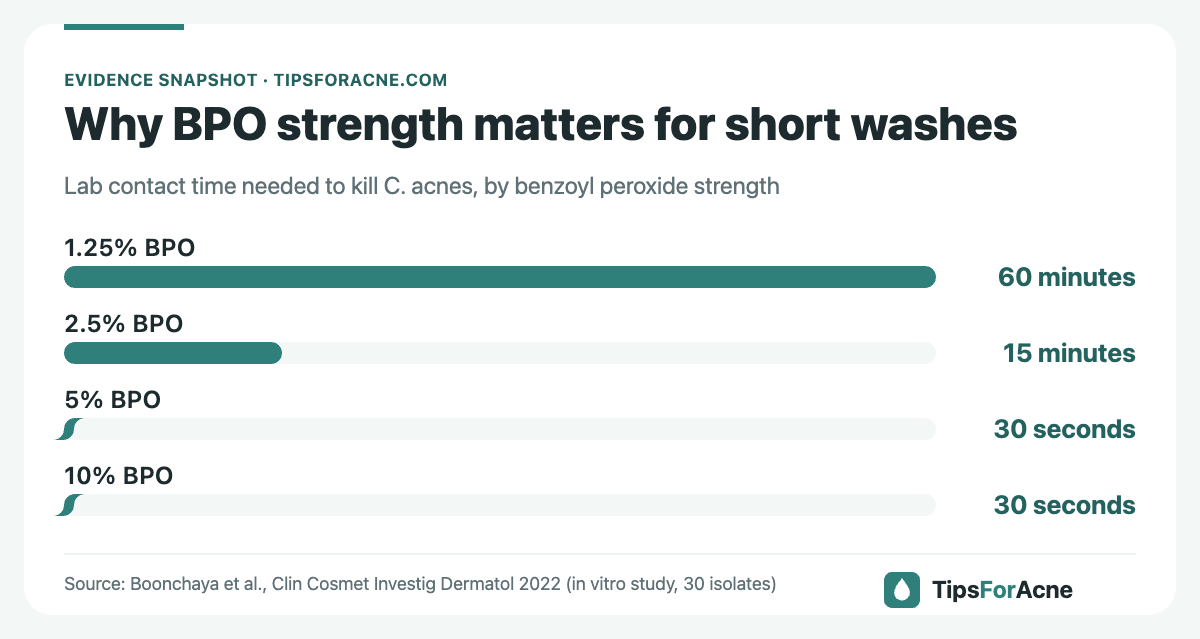
How strong is the evidence for that exact approach? Modest. A 2022 lab study that tested 30 representative C. acnes strains found 5% and 10% BPO killed the bacteria within 30 seconds of contact, while 2.5% needed 15 minutes and 1.25% needed 60. That is in a dish, though, and the authors note that real skin differs: the product has to reach into follicles and gets diluted by water. On actual backs, a 2010 review of truncal BPO studies reported that one study found no reduction in C. acnes counts on the back after treatment with an 8% BPO wash, whereas a 5.3% foam rinsed off after five minutes produced a small reduction. So short-contact washing is a reasonable, practical option, but the direct evidence that it clears back acne is thin.
One practical warning: BPO bleaches hair and dyed fabric. Rinse thoroughly and use white towels and old T-shirts.
Salicylic acid
The AAD suggests salicylic acid products for sweat-and-friction breakouts because it helps unclog pores, and US OTC products may contain 0.5% to 2%. The evidence base is weaker than for BPO: the 2024 AAD guideline gives salicylic acid only a conditional recommendation, and a 2020 Cochrane review rated most of its comparisons as low or very low certainty. A salicylic acid body wash is a sensible option if BPO irritates you or ruins your laundry, but don’t expect it to outperform BPO.
Adapalene and other retinoids
The AAD recommends adding a retinoid such as adapalene, applied after showering or before bed, because it unclogs pores and helps BPO work better. Topical retinoids have a strong recommendation in the 2024 guideline. However, the 2023 truncal acne review notes that treatment guidance for the trunk is largely derived from facial protocols, and adapalene’s trial data are mainly facial. Covering a whole back uses a lot of product, and irritation is common in the first weeks; my notes on starting it are in adapalene (Differin). Retinoids are generally avoided in pregnancy; the AAD advises stopping adapalene and tretinoin while pregnant.
Trifarotene: the one retinoid tested on backs
Trifarotene 50 µg/g cream (a prescription retinoid) is notable because its phase 3 trials measured the trunk as a separate outcome. The PERFECT 1 and 2 trials enrolled people aged 9 and older with moderate facial and truncal acne for 12 weeks, and truncal success was significantly better than vehicle (P < .001). According to a 2026 review of the trial data, truncal success rates were 35.7% to 42.6% with trifarotene versus 25.0% to 29.9% with vehicle, and fewer than 2% of patients stopped because of skin reactions. That’s a real but moderate benefit, and these were manufacturer-funded trials. Whether it suits you is a question for a prescriber.
| Option | How it’s used on the back | Evidence for the trunk specifically | Main downsides |
|---|---|---|---|
| Benzoyl peroxide wash (OTC, 2.5–10%) | In the shower, left on 2–5 minutes, then rinsed | Limited: lab data on contact time; small, mixed studies on backs | Dryness, irritation, bleaches fabric |
| Salicylic acid wash or spray (OTC, 0.5–2%) | Wash or leave-on after sweating | Weak; conditional guideline recommendation, low-certainty trials (mostly facial) | Dryness, stinging |
| Adapalene 0.1% gel (OTC) | Thin layer once daily on dry skin | Extrapolated from facial trials | Irritation early on; avoid in pregnancy |
| Trifarotene cream (Rx) | Once daily, as prescribed | Two phase 3 RCTs with truncal outcomes | Irritation; prescription only |
| Oral treatments (Rx) | Antibiotics with BPO, hormonal options, isotretinoin | Mostly extrapolated from facial acne trials | Systemic side effects; clinician-managed |
How do you build a simple back acne routine?
- Shower soon after sweating. The AAD’s advice is to shower and change clothes as soon as possible after working out, and to choose loose cotton or sweat-wicking workout clothes.
- Use a BPO wash, and give it time. Lather onto the back, leave it for two to five minutes (wash your hair or shave in the meantime), then rinse well. Start every other day if your skin is sensitive; details are in benzoyl peroxide for acne.
- Add a retinoid once the wash is tolerated. A thin layer of adapalene on dry skin at night. A long-handled applicator or a helper makes this easier.
- Cut friction. Swap backpack straps for a bag you carry by hand when you can, and put clean, soft padding between sports equipment and skin.
- Be gentle. The AAD warns that scrubbing acne-prone skin actually worsens acne, and suggests avoiding antibacterial soaps, astringents and abrasive scrubs.
- Be patient. The AAD says results may appear in six to eight weeks, and complete clearing can take three or four months.
Does back acne scar more?
It can. The AAD notes that raised hypertrophic scars often appear on the jawline and trunk, and that raised scars are more common in darker skin tones. NICE’s guideline says people with acne with scarring or persistent pigment changes should be referred to a dermatologist. If you’re left with marks, acne scars vs dark spots explains which fade on their own and which don’t.
When to see a dermatologist: Book an appointment if you have deep, painful lumps or cysts on your back or chest, if spots are leaving raised or pitted scars, or if a consistent OTC routine hasn’t helped after the six to eight weeks the AAD suggests. Also see a clinician if the bumps are very itchy and uniform (possible fungal folliculitis), appeared after starting steroids or testosterone, or if acne on your body is affecting your mood or what you’re willing to wear. Prescription options, including retinoids, antibiotics, hormonal treatment and isotretinoin, are a conversation to have with them.
Kelsey’s take
It surprised me that most back acne advice is borrowed from face studies, so we’re mostly extrapolating. Still, a benzoyl peroxide wash left on for a few minutes plus a retinoid sounds like a sensible, low-drama place to start. I’d want to ask a dermatologist whether my bumps look like true acne or fungal folliculitis, and how long to give a routine before switching.
Frequently asked questions
What causes acne on your back?
The same things that cause facial acne: excess oil, clogged pores, C. acnes bacteria and inflammation. The back has many oil glands, and sweat, heat and friction from backpacks, tight clothes or sports gear can make it flare, according to the AAD. Family history, some steroid medicines and testosterone can also play a role.
How long should I leave benzoyl peroxide wash on my back?
The American Academy of Dermatology suggests leaving a benzoyl peroxide wash on the back for two to five minutes before rinsing, because back skin is thicker than facial skin. Lab data suggest 5% or stronger acts quickly, but real-world evidence for short-contact washing on backs is limited. Rinse well, because it bleaches fabric.
Can I use adapalene (Differin) on my back?
Adapalene 0.1% is sold over the counter for acne, and the AAD suggests pairing a retinoid with a benzoyl peroxide wash for back acne. Its trials were mostly on faces, so back use is extrapolated. Expect dryness and irritation in the first weeks, use a thin layer, and avoid it during pregnancy unless your doctor advises otherwise.
Why won’t my back acne go away?
Common reasons are not giving treatment long enough (the AAD says 6 to 8 weeks to see results), ongoing friction or sweat, or that it isn’t acne at all. Small, itchy, uniform bumps on the upper back may be fungal folliculitis, which needs antifungals. If a consistent routine fails, a dermatologist can confirm the diagnosis and discuss prescription options.
Is salicylic acid or benzoyl peroxide better for back acne?
Benzoyl peroxide has the stronger evidence: it gets a strong recommendation in the 2024 AAD acne guideline, while salicylic acid gets a conditional one and its trials are rated low certainty. Salicylic acid is a reasonable alternative if benzoyl peroxide irritates your skin or bleaches too many towels, and it doesn’t stain fabric.
Sources
- American Academy of Dermatology. Back acne: How to see clearer skin. aad.org
- American Academy of Dermatology. Is sports equipment causing your acne? aad.org
- Reynolds RV, Yeung H, Cheng CE, et al. Guidelines of care for the management of acne vulgaris. Journal of the American Academy of Dermatology, 2024;90(5):1006.e1-1006.e30. pubmed.ncbi.nlm.nih.gov
- Tan J, Del Rosso JQ, Weiss JS, et al. Prevalence and demographics of truncal involvement among acne patients: survey data and a review of the literature. Journal of Clinical and Aesthetic Dermatology, 2022;15(10):62-67. jcadonline.com
- Daniele SG, Kim SR, Grada A, Moore AY, Suozzi KC, Bunick CG. Truncal acne and scarring: a comprehensive review of current medical and cosmetic approaches to treatment and patient management. American Journal of Clinical Dermatology, 2023;24:199-223. link.springer.com
- Tan J, Thiboutot D, Popp G, et al. Randomized phase 3 evaluation of trifarotene 50 μg/g cream treatment of moderate facial and truncal acne. Journal of the American Academy of Dermatology, 2019;80(6):1691-1699. pubmed.ncbi.nlm.nih.gov
- Krawchuk JP, Tamucci K. Trifarotene for facial and truncal acne vulgaris: a narrative review of clinical trial evidence. Cureus, 2026;18(8):e114659. pmc.ncbi.nlm.nih.gov
- Boonchaya P, Rojhirunsakool S, Kamanamool N, et al. Minimum contact time of 1.25%, 2.5%, 5%, and 10% benzoyl peroxide for a bactericidal effect against Cutibacterium acnes. Clinical, Cosmetic and Investigational Dermatology, 2022;15:403-409. dovepress.com
- Bikowski J. A review of the safety and efficacy of benzoyl peroxide (5.3%) emollient foam in the management of truncal acne vulgaris. Journal of Clinical and Aesthetic Dermatology, 2010;3(11):26-29. jcadonline.com
- Liu H, Yu H, Xia J, et al. Topical azelaic acid, salicylic acid, nicotinamide, sulphur, zinc and fruit acid (alpha-hydroxy acid) for acne. Cochrane Database of Systematic Reviews, 2020 (plain language summary). cochrane.org
- US Code of Federal Regulations. 21 CFR Part 333 Subpart D: Topical Acne Drug Products. ecfr.gov
- DermNet. Malassezia folliculitis. dermnetnz.org
- Nair PA, Saleh HM, Salazar FJ. Acneiform Eruptions. StatPearls (NCBI Bookshelf), updated 2024. ncbi.nlm.nih.gov
- American Academy of Dermatology. Acne scars: Signs and symptoms. aad.org
- American Academy of Dermatology. Acne: Who gets and causes. aad.org
- American Academy of Dermatology. Is any acne treatment safe to use during pregnancy? aad.org
- National Institute for Health and Care Excellence (NICE). Acne vulgaris: management (NG198), 2021. nice.org.uk
Cite this page: TipsForAcne, “Back Acne: Causes, What Works, and How to Treat It”, tipsforacne.com/back-acne/ (updated ). Free to quote with attribution and a link to this page.
Source links on this site are checked every month; last check . How sources are checked.