| Where the guideline stands | Insufficient evidence to recommend either way |
| Availability | In clinic |
| How long before you judge it | A series of sessions |
| Pregnancy | Discuss with your clinician. |
| Sources behind this page | 8, every one linked at the bottom |
What it is
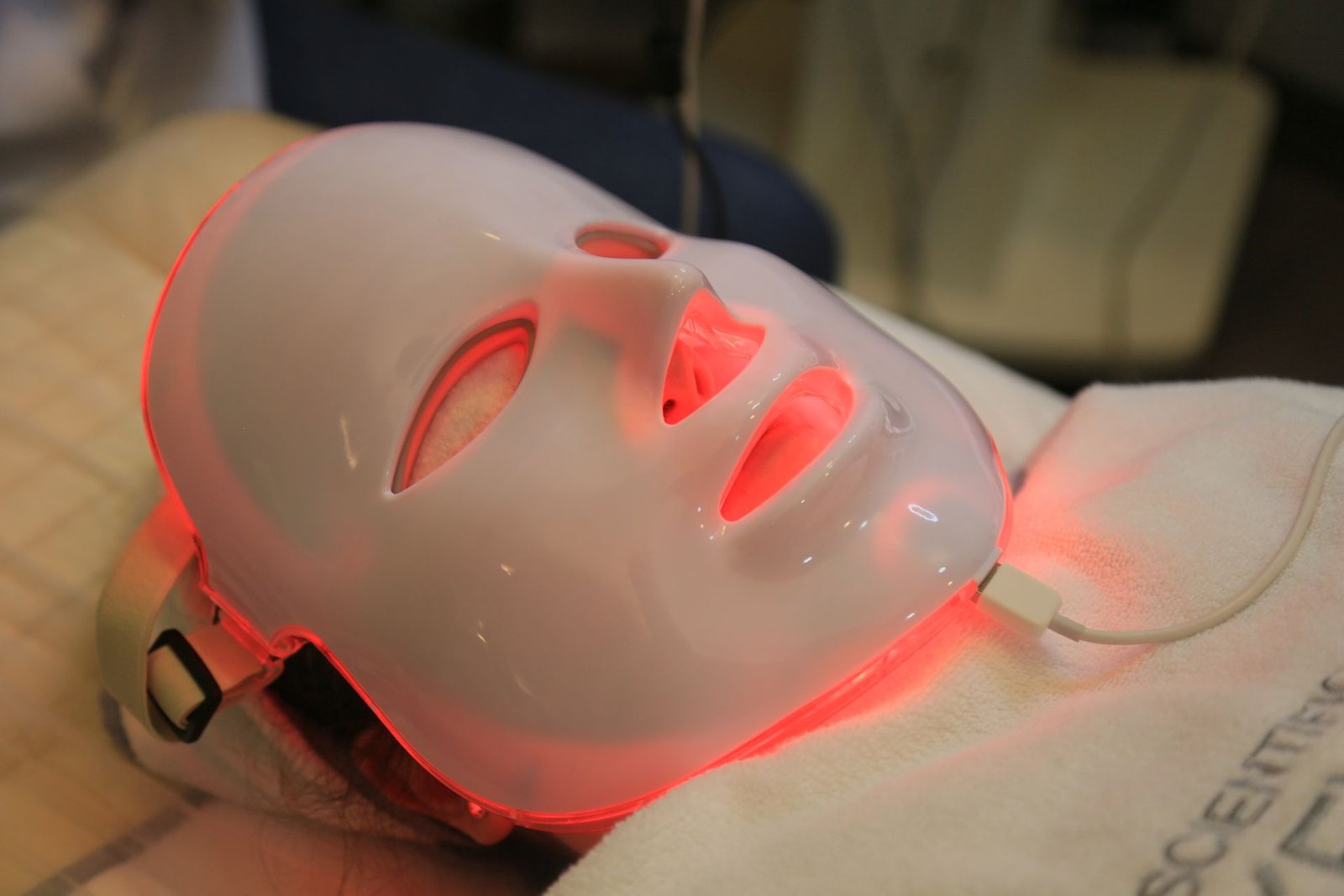
“Laser and light therapy” is an umbrella term covering several quite different machines with different targets. Blue light around 415 nm is absorbed by porphyrins produced by Cutibacterium acnes, generating free radicals that damage the bacteria. Red light around 630 nm penetrates deeper and is proposed to damp inflammation. Pulsed dye, potassium titanyl phosphate and intense pulsed light devices target blood vessels and redness. Infrared devices (the 1450 nm diode, and newer 1726 nm lasers) aim heat at the sebaceous gland itself. They reach people in two very different forms: in-clinic systems operated by a practitioner, and at-home LED masks and wands cleared for over-the-counter sale.
What the evidence actually shows
The AAD work group’s conclusion is a single sentence: “Available evidence is insufficient to develop a recommendation on the use of … laser and light-based devices (including 585-595 nm pulsed dye laser, neodymium-doped yttrium aluminum garnet laser, 1450 diode laser, potassium titanyl phosphate laser, infrared light-emitting diode, 635-670 nm red light, combined 420 nm blue light and 660 nm red light, 589 nm/1319 nm laser, or intense pulsed light) … for the treatment of acne.” The list is worth reading, because it shows the group reviewed these devices by wavelength and type and still could not reach a verdict on any of them.
The reason is the shape of the literature, not its volume. The 2016 Cochrane review of light therapies for acne included 71 studies with 4211 participants, rated the evidence very low quality for most comparisons, and concluded that high-quality evidence on light therapies for acne is lacking. A 2024 systematic review of visible light alone found 35 studies covering 1185 cases, reported that 92% of patients achieved partial remission and that total lesion counts improved 43% by week four, then noted that the trials had limited sample sizes and diverse, hard-to-compare outcome measures.
Individual trials show the problem directly. In a randomised, single-blind, split-face trial published in JAMA in 2004, 40 patients received non-purpuric 585 nm pulsed dye laser to one side of the face. Papule counts fell 4.2 on the treated side versus 2.2 untreated (P=.08), pustules and comedones showed no advantage, and acne severity scores did not differ (P>.99). The authors concluded the laser “did not result in significant improvement of facial acne.”
The recurring design flaw is that most studies compare one device against another, or against an untreated side, rather than against the same machine with the light switched off. That leaves the contribution of attention, cleansing and simple passage of time unseparated from the device.
How it is actually used
If you are considering this, treat it as unproven rather than proven. In-clinic courses run as a series of sessions weeks apart, and the cost is out of pocket; Aetna’s medical policy, for one, classifies laser, LED, intense pulsed light, photodynamic and home light devices for acne as experimental, investigational or unproven. FDA clearance does not close the gap: the over-the-counter Neutrogena Light Therapy Acne Mask+ and Cutera’s AviClear laser were both cleared through the 510(k) substantial-equivalence route, which asks whether a device resembles an earlier cleared one, not whether it beats a sham. The treatments carrying strong, moderate-certainty recommendations (benzoyl peroxide, topical retinoids, topical antibiotics and their fixed-dose combinations) cost a fraction as much. If you try a device anyway, keep the topical regimen going and judge it against photographs, not memory.
Safety and who should avoid it
Light devices are generally well tolerated in trials, with transient redness, dryness and mild stinging most commonly reported. The Cochrane review found scarring reported as absent, but blistering was reported in studies of intense pulsed light, infrared light and photodynamic therapy. Pigment change is the risk that matters most in darker skin, and it is under-studied. Replace the colon with a full stop and de-link the two claims: “Johnson & Johnson voluntarily recalled the Neutrogena Light Therapy Acne Mask in 2019. The Health Canada notice describes the recall as taken out of an abundance of caution and does not state a hazard.” Long-term safety data (repeated courses over years) essentially do not exist for any of these devices, at home or in clinic.
Commonly repeated: The AAD guideline says lasers and light therapy don’t work for acne. What the evidence actually shows: It says no such thing. The guideline places laser and light devices in an “insufficient evidence” statement, which under GRADE means the work group could not make a recommendation in either direction, neither for nor against. The only thing the 2024 guideline actually recommends against is adding pneumatic broadband light to adapalene 0.3% gel.
Sources
- Reynolds RV, Yeung H, Cheng CE, et al. Guidelines of care for the management of acne vulgaris, J Am Acad Dermatol 2024
- Barbaric J, Abbott R, Posadzki P, et al. Light therapies for acne, Cochrane Database of Systematic Reviews 2016
- Orringer JS, Kang S, Hamilton T, et al. Treatment of Acne Vulgaris With a Pulsed Dye Laser: A Randomized Controlled Trial, JAMA 2004;291(23):2834-2839
- Akuffo-Addo E, Ramsay K, Mohsen S, et al. Visible Light in the Treatment of Acne Vulgaris, J Cutan Med Surg 2024
- Aetna Clinical Policy Bulletin 0656: Phototherapy for Acne
- FDA 510(k) K180847: Neutrogena Light Therapy Acne Mask+ clearance summary
- FDA 510(k) K213461: AviClear Laser System clearance letter, 2022
- Health Canada recall notice: Neutrogena Light Therapy Acne Mask, 2 July 2019
Keep reading
See where this sits against every other acne treatment on the acne treatment evidence map, or check how it combines with another ingredient in the ingredient combination checker. For the guideline’s own wording on this, see the 2024 AAD guideline, recommendation by recommendation.
Not medical advice
This page reports what the published evidence says about a treatment. It is not a treatment plan and it cannot account for your skin, your other medications or your medical history. Nothing here has been reviewed by a clinician; see our editorial policy for what that means. Talk to a clinician before starting or stopping any prescription treatment.